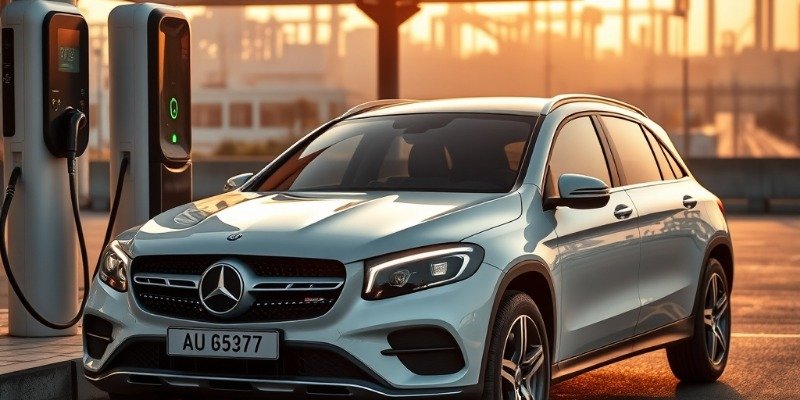
Mercedes-Benz will launch the GLC Electric in India on November 4, 2026. The electric SUV will be assembled at the company's Chakan plant in Pune, making it the fastest global Mercedes model to arrive in India as a locally assembled vehicle just six months after European sales began. Bookings open in October. The India-spec GLC 400 4Matic brings a 94kWh battery, dual-motor all-wheel drive producing 490hp and 800Nm, and a claimed WLTP range of 715km. But the headline figure for infrastructure watchers is the charging capability: up to 330kW DC fast charging, which Mercedes claims can add 300km of range in 10 minutes and achieve 10-80% charge in roughly 22 minutes under suitable conditions.
The vehicle's charging capability sets a high bar
The GLC Electric supports charging speeds that exceed what almost any public charger in India can currently deliver. Most operational DC fast chargers in the country today peak at 120kW to 180kW. A handful of newer stations along major highways offer 240kW or 300kW, but these are exceptions concentrated on specific corridors like Delhi-Mumbai or Delhi-Jaipur. The GLC's 330kW capability means the vehicle is technically ready for the next generation of ultra-fast chargers, but the infrastructure to utilise that potential remains sparse.
Mercedes-Benz acknowledges this gap. The company's own communication notes that "a 330kW-capable car does not mean every Indian charging station can deliver 330kW" and that actual charging speed depends on the charger, its available power, battery temperature, and state of charge. This is an honest assessment: the GLC Electric is future-proofed for infrastructure that is still being built.
India's premium charging landscape today
Public charging in India has grown rapidly but remains uneven. Charge point operators like Statiq, ChargeZone, Glida, and Zeon have deployed networks along major highways and in metro cities. However, the majority of stations offer 60kW to 120kW output. High-power corridors exist but coverage gaps persist, especially beyond the golden quadrilateral and major state highways. Reliability is another concern — broken connectors, payment failures, and queueing during peak travel periods are common complaints among existing EV owners.
For a vehicle priced between Rs 80 lakh and Rs 90 lakh ex-showroom, the buyer profile is likely to include long-distance travellers who expect seamless highway charging. The GLC Electric's real-world range of 550-600km in Indian conditions (versus the 715km WLTP claim) means highway legs of 350-400km between charges are realistic. This demands chargers that can deliver at least 150kW consistently to keep stop times around 30-40 minutes. Anything slower erodes the time advantage that makes EVs viable for inter-city travel.
Home and destination charging remain the backbone
Most GLC Electric owners will charge at home or at workplace destinations. Mercedes-Benz will likely offer a wallbox solution for overnight AC charging, which at 11kW or 22kW can replenish the 94kWh battery fully in 5-9 hours. This covers daily commuting comfortably. The challenge arises on road trips, where the public network must bridge the gap. The GLC's standard 4.5-degree rear-axle steering and air suspension (on international spec) suggest a vehicle designed for long-distance comfort, reinforcing the need for reliable highway charging.
The competitive context raises the stakes
The GLC Electric arrives as the premium electric SUV segment expands. BMW's iX3 Long Wheelbase is slated for 2027. Audi, Volvo, and other brands have similar products in the pipeline. Each new launch with 200kW-plus charging capability increases the pressure on charge point operators to upgrade. The business case for ultra-fast chargers improves as more high-voltage-architecture vehicles hit the road, but deployment timelines — land acquisition, grid upgrades, permits — mean infrastructure typically lags vehicle launches by 12-24 months.
What this means for the November 4 launch
Buyers taking delivery in late 2026 and early 2027 will find a charging network that works for city driving and planned highway trips on well-served routes. They will not find ubiquitous 330kW charging. Mercedes-Benz has not announced a proprietary charging network for India, unlike some rivals. The brand will likely rely on partnerships with existing operators and possibly dealer-installed chargers at dealerships. Prospective buyers should map their regular long-distance routes against current charger locations and speeds before committing.
The GLC Electric is a technically impressive vehicle that retains the familiar GLC proportions, practicality (570-litre boot, 128-litre frunk), and luxury appointments including the 39.1-inch MBUX Hyperscreen. Its local assembly helps keep pricing competitive. But the ownership experience beyond city limits will be defined as much by ChargeZone and Statiq as by Mercedes-Benz. The premium electric SUV wave is arriving; the charging network is still catching up.
FAQs
When does the Mercedes-Benz GLC Electric launch in India?
The Mercedes-Benz GLC Electric launches in India on November 4, 2026. Bookings are scheduled to open in the first week of October 2026.
What is the expected price of the GLC Electric in India?
Industry estimates place the GLC Electric between Rs 80 lakh and Rs 90 lakh ex-showroom. The final price will be announced closer to launch.
How fast can the GLC Electric charge on public chargers?
The GLC 400 4Matic supports up to 330kW DC fast charging. Under suitable conditions, it can add up to 300km of WLTP range in 10 minutes and achieve 10-80% charge in approximately 22 minutes. Actual speeds depend on the charger's capability, which in India currently peaks at 240-300kW on select highways.
What is the real-world driving range in Indian conditions?
Mercedes claims a WLTP range of 715km. Based on Indian driving conditions — heat, traffic, air-conditioning use, and highway speeds — a realistic range estimate is 550-600km.
Will the GLC Electric be locally assembled in India?
Yes. The GLC Electric will be assembled at Mercedes-Benz's Chakan plant in Pune. This makes it the fastest global Mercedes model to arrive in India as a locally assembled vehicle, just six months after European sales began.