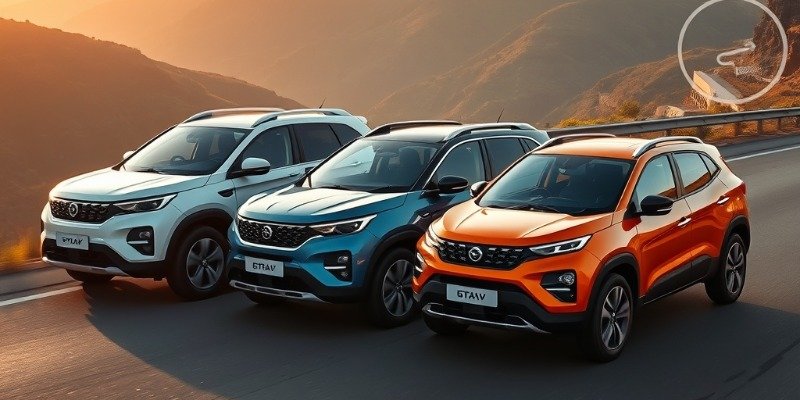
Tata Motors is preparing its strongest electric vehicle lineup yet for the Indian market. By late 2026 and into 2027, the company plans to launch three major electric SUVs that will cover very different buyer segments. The Tata Safari EV will arrive first as a family-focused seven-seater with serious off-road ability. The Tata Avinya X will follow as the brand's first premium coupe-SUV built on a new platform. The next-generation Nexon EV, codenamed Project Garud, will complete the trio as a volume seller with a completely fresh design. This article compares all three models using the latest confirmed information from official sources and industry reports.
Tata Safari EV: The Family Off-Roader
The Safari EV is expected to launch around Diwali 2026. Production is scheduled to begin in August 2026. The design will stay close to the current Safari silhouette, but the powertrain brings major changes. Two battery options are planned: a 65 kWh pack and a larger 75 kWh pack. Claimed range falls between 550 and 600 kilometres depending on the variant.
Lower variants will use a rear-wheel-drive layout. Higher variants will get a dual-motor quad-wheel-drive system. This setup improves acceleration and gives the Safari genuine off-road capability for the first time. The feature list mirrors the Harrier EV with dual screens, Level 2 ADAS, a 540-degree camera, panoramic sunroof, and ventilated front and rear seats. A standout feature is Summon Mode, which lets the driver move the vehicle forward or backward using the key fob. This helps in tight parking spots or when another car blocks the doors.
Expected pricing starts near ₹20 lakh for the base model and goes up to ₹30-32 lakh for the top quad-wheel-drive variant. The Safari EV targets family buyers who need seven seats, long range, and the ability to handle rough roads.
Tata Avinya X: The Premium Coupe-SUV
The Avinya X is not just a new model; it is the first production vehicle under Tata's new Avinya premium EV brand. The concept was shown at the Bharat Mobility Expo in January 2025. It uses a coupe-SUV body style with a sloping roof, matrix LED lighting, active aerodynamics, and a wide stance. The platform is the Chery-JLR Freelander EV architecture, confirmed in mid-2026. This change from the earlier JLR EMA plan was made to control costs and speed up development.
Battery options are expected between 65 and 80 kWh. The target is a claimed range of 500 kilometres or more. The interior focuses on luxury with a multi-screen dashboard, panoramic glass roof, lounge-style rear seats, a fabric-wrapped soundbar, aroma diffuser, and wellness features. Level 2 ADAS will be standard. Drive configurations could include rear-wheel drive and all-wheel drive variants.
Manufacturing is planned at the new Panapakkam plant in Tamil Nadu. Launch is targeted for 2027, possibly with a reveal at the Bharat Mobility Expo early that year. Estimated ex-showroom pricing ranges from ₹35 lakh to ₹60 lakh, with most trackers clustering around ₹40-45 lakh. On-road prices will likely land between ₹46 lakh and ₹55 lakh. The Avinya X will be sold through separate boutique showrooms, not regular Tata dealerships. It competes with vehicles like the Hyundai Ioniq 5, BYD Sealion 7, and Mahindra XEV 9e.
Next-Gen Nexon EV (Project Garud): The Volume Leader
The next-generation Nexon EV carries the internal codename Project Garud. It marks the first clean-sheet redesign since the Nexon launched in 2017. The current model received facelifts in 2020 and 2023. The new generation is expected around mid-2027, roughly in time for Diwali.
The design will adopt Tata's latest language with sharper front styling, new LED signatures, and a completely new interior. A triple-screen dashboard setup similar to the Curvv is likely. Features will include Summon Mode, panoramic sunroof, and ADAS. The platform remains the X1 architecture but heavily updated for new safety standards, better refinement, and improved driving dynamics.
Powertrain options will include the 1.2-litre turbo petrol and 1.2-litre petrol-CNG for ICE versions. The diesel engine's future is uncertain. For the EV version, significant upgrades are promised over the current 30 kWh and 45 kWh packs, though exact battery sizes and range figures have not been officially revealed. The current Nexon EV offers 275 to 489 kilometres of claimed range and 142 bhp from the 45 kWh variant. Pricing for the new generation is not yet announced, but the current model sells between ₹12.49 lakh and ₹17.89 lakh ex-showroom.
How They Compare
The three vehicles serve distinct purposes. The Safari EV is a practical seven-seater with off-road hardware and a price band of ₹20-32 lakh. It arrives first in late 2026. The Avinya X is a premium five-seater coupe-SUV with luxury appointments, a dedicated retail channel, and a price band of ₹35-60 lakh. It arrives in 2027. The next-gen Nexon EV is a five-seater compact SUV aimed at the mass market with a completely fresh design and updated EV powertrain. It also arrives in 2027.
Buyers needing a family hauler with genuine four-wheel-drive capability should watch the Safari EV. Buyers wanting a premium electric experience with boutique service and standout design should track the Avinya X. Buyers looking for a feature-packed compact EV with strong value should wait for the next-gen Nexon EV. All three will coexist in Tata's lineup without direct overlap.
The Safari EV and next-gen Nexon EV will use existing dealer networks. The Avinya X requires a new sales channel, which may limit initial availability in smaller cities. The Safari EV's quad-wheel-drive system is unique in this group. The Avinya X's Freelander platform and boutique positioning are unique. The next-gen Nexon EV's triple-screen interior and Summon Mode trickle down premium features to a lower price point.
Which One Should You Wait For?
If you need an electric SUV in late 2026 and want seven seats with off-road ability, the Safari EV is the only option arriving on time. If you can wait until 2027 and want a premium electric vehicle with a distinct design and luxury cabin, the Avinya X is worth tracking. If you want a compact electric SUV with the latest technology at a mainstream price, the next-gen Nexon EV is the logical choice. Current Nexon EV owners facing a purchase decision in 2026 should evaluate whether the current model's 489-kilometre range and 5-star safety rating meet their needs, or if the new generation's upgrades justify the wait.