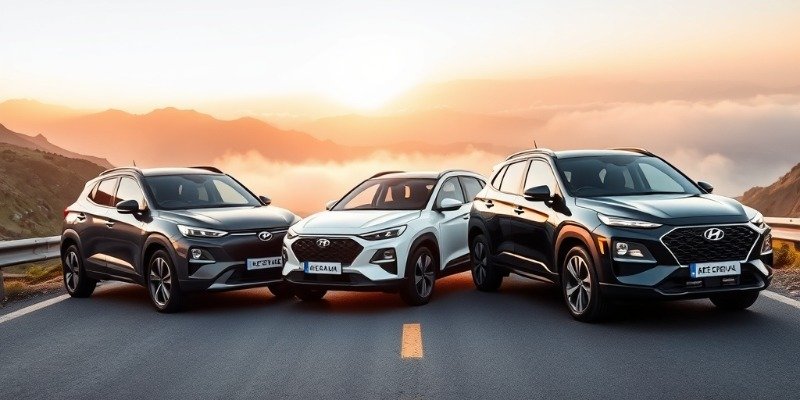
The Indian electric SUV space is heating up just in time for winter. Three distinct contenders are vying for buyers who want long range, modern features, and coupe-SUV styling without crossing the ₹20 lakh threshold. Hyundai's upcoming Ioniq P, Tata's Curvv.ev, and Mahindra's BE 6 each take a different approach to the same brief. Here is how they stack up on the metrics that matter.
Price positioning and variant strategy
Tata Curvv.ev currently holds the entry advantage. Its 55 kWh long-range variant starts at ₹16.99 lakh ex-showroom, while the 45 kWh version sits even lower. Mahindra BE 6 opens at ₹18.90 lakh for the Pack One trim with a 59 kWh battery. Hyundai Creta EV, the brand's current mass-market electric SUV, lists its long-range 51.4 kWh version at ₹18.02 lakh. The Ioniq P is confirmed for a December 2026 India debut, but pricing has not been announced. If Hyundai positions it competitively, it could slot between the Curvv.ev and BE 6, making the three-way fight even tighter.
Battery packs and claimed range
Mahindra leads on paper. The BE 6 offers two battery options on its dedicated INGLO skateboard platform: a 59 kWh pack with a 557 km ARAI claim and a 79 kWh pack rated at 682 km. Tata Curvv.ev uses 45 kWh and 55 kWh packs on an adapted architecture, delivering 502 km and 585 km respectively under the MIDC cycle. Hyundai Creta EV fields 42 kWh and 51.4 kWh batteries for 390 km and 473 km ARAI figures. Real-world ranges typically run 20 to 25 percent lower than certified numbers across all three. For buyers prioritising maximum kilometres per charge, the BE 6's larger packs give it a clear edge.
Charging speed and convenience
Mahindra again claims the fastest DC top-up. The BE 6 can move from 20 to 80 percent in 20 minutes on a 175 kW charger. Tata Curvv.ev manages 10 to 80 percent in 40 minutes on a 70 kW unit. Hyundai Creta EV's 51.4 kWh pack needs 58 minutes for the same 10 to 80 percent window on a DC fast charger. On AC home charging, the BE 6 takes 6 to 11.7 hours depending on battery size and wall-box rating, the Curvv.ev about 7.9 hours on a 7.2 kW unit, and the Creta EV roughly 4.5 hours on an 11 kW charger. For highway trips with brief stops, Mahindra's architecture is the most accommodating.
Performance and driving character
The BE 6 is engineered as a driver's car. Its rear-wheel-drive layout, 282 bhp and 380 Nm in the 79 kWh guise, and a claimed 0 to 100 kmph time of 6.7 seconds make it the quickest of the trio. Tata Curvv.ev's 55 kWh version produces 165 bhp and 215 Nm, hitting 100 kmph in 8.6 seconds with front-wheel drive. Hyundai Creta EV's long-range variant delivers 171 bhp and 255 Nm, also front-driven, with a 7.9 second sprint. If engagement matters, Mahindra's tune is in a different league. For relaxed daily commutes, the Tata and Hyundai calibrations are more than adequate.
Platform architecture and packaging
Mahindra's INGLO platform is a clean-sheet electric skateboard, which explains the long 2775 mm wheelbase, flat floor, and rear-drive proportions. Tata's Curvv.ev stretches the Nexon's underpinnings, resulting in a 2560 mm wheelbase and front-drive layout. Hyundai's Creta EV adapts the existing Creta platform, also front-drive. The BE 6 measures 4371 mm long, 1907 mm wide, and 1627 mm tall with 207 mm ground clearance. The Curvv.ev is 4310 mm long, 1810 mm wide, 1637 mm tall with 186 mm clearance. The Creta EV dimensions closely mirror the ICE Creta. Boot space favours the Curvv.ev at 500 litres plus an 11.6 litre frunk. The BE 6 offers 455 litres plus a 45 litre frunk. Creta EV boot figures have not been officially detailed yet.
Interior design and feature sets
Mahindra goes maximalist. The BE 6 cockpit features dual 12.3 inch screens, a 16-speaker Harman Kardon system with Dolby Atmos, six drive modes, a head-up display, autonomous parking, and an aircraft-inspired centre console. Tata Curvv.ev counters with a panoramic sunroof, powered tailgate, 12.3 inch touchscreen and digital cluster, JBL audio with four speakers, tweeters and a subwoofer, Hinglish voice commands, and the iRA.ev connected suite. Both get Level 2 ADAS suites with adaptive cruise, lane keep, and automatic emergency braking. Hyundai Creta EV's feature list is still emerging but is expected to include dual screens, ADAS, and Hyundai's Bluelink connected car tech. The BE 6 feels like a concept car made real; the Curvv.ev balances wow-factor with everyday usability.
Safety credentials
Tata Curvv.ev has already secured a 5-star Bharat NCAP rating for both adult and child occupancy, backed by six airbags, ESC, TPMS, and a comprehensive ADAS package. Mahindra BE 6 offers seven airbags, ESC, TPMS, and a similarly strong ADAS suite, though its Bharat NCAP rating is awaited. Hyundai Creta EV is expected to target a 5-star outcome with six airbags and ADAS on higher trims. All three are engineered to high safety standards, but Tata has the certified proof today.
Running costs and ownership
Home-charged running costs converge around ₹1 to ₹1.4 per kilometre for all three. Service intervals are light on dedicated EV platforms. Tata's wider service network beyond metros remains a structural advantage. Mahindra's INGLO warranty cover is generous, and Hyundai's Bluelink ecosystem adds remote monitoring convenience. Resale value trends will only emerge after a few years, but brand trust and network depth currently tilt toward Tata.
The Ioniq P wildcard
Hyundai's Ioniq P is listed among new electric and hybrid cars coming to India by December 2026. No specifications, pricing, or launch timeline beyond "winter" have been confirmed. If it arrives with a competitive battery pack and aggressive pricing, it could disrupt the current value equation. Until then, the showdown is effectively between the Creta EV, Curvv.ev, and BE 6.
Which one should you choose
If maximum range, outright performance, and a cabin that feels like nothing else on the road are your priorities, the Mahindra BE 6 Pack One at ₹18.90 lakh is the range king and the driver's pick. If you want the best balance of price, boot space, rear-seat comfort, proven safety ratings, and a familiar ownership experience, the Tata Curvv.ev 55 kWh at ₹16.99 lakh is the practical champion. If you prefer a conventional SUV silhouette with Hyundai's feature polish, dealer network, and a slightly lower entry point for the long-range variant, the Creta EV 51.4 kWh at ₹18.02 lakh makes a strong case. The Ioniq P remains an unknown quantity — worth a wait only if your purchase timeline extends into early 2027 and you are willing to gamble on an unproven model.
FAQs
What is the starting price of each EV under ₹20 lakh
Tata Curvv.ev 55 kWh starts at ₹16.99 lakh, Hyundai Creta EV 51.4 kWh at ₹18.02 lakh, and Mahindra BE 6 Pack One 59 kWh at ₹18.90 lakh. All prices are ex-showroom.
Which EV offers the highest claimed range in this segment
Mahindra BE 6 with the 79 kWh battery claims 682 km ARAI. Among base variants under ₹20 lakh, the BE 6 59 kWh claims 557 km, ahead of Curvv.ev 55 kWh at 502 km and Creta EV 51.4 kWh at 473 km.
How fast can each EV charge from 20 to 80 percent on DC
Mahindra BE 6 takes 20 minutes on a 175 kW charger. Tata Curvv.ev needs 40 minutes on a 70 kW charger. Hyundai Creta EV requires 58 minutes on a DC fast charger.
Which EV has the largest boot space
Tata Curvv.ev leads with 500 litres plus an 11.6 litre frunk. Mahindra BE 6 offers 455 litres plus a 45 litre frunk. Hyundai Creta EV boot capacity has not been officially disclosed.
Is the Hyundai Ioniq P confirmed for launch this winter
Hyundai Ioniq P is mentioned in industry reports as one of the new electric cars coming to India by December 2026. No official launch date, specifications, or pricing have been announced by Hyundai India.