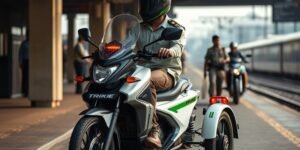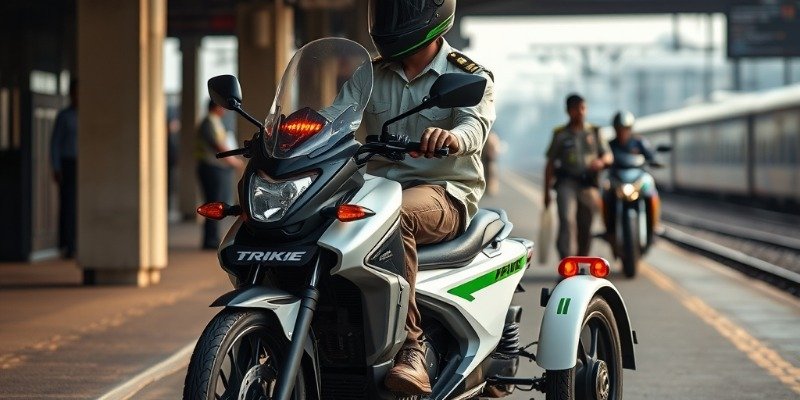
A compact three-wheeled electric patrol vehicle developed by a student engineer in Coimbatore has moved from campus prototype to active duty with police forces. The Trike 2π, created by Shakeel Akthar S during his studies at Kumaraguru College of Technology, has been named a national runner-up at the James Dyson Award 2026 in India. What began as a solution for navigating a 150-acre campus has evolved into a purpose-built mobility tool now used by Coimbatore City Police and Railway Protection Force personnel at Chennai Central Railway Station.
How the Trike 2π Works
The Trike 2π uses a front-wheel-drive layout with a hub-mounted 250W motor. This power output keeps the vehicle within India's low-speed vehicle regulations. The front wheel provides a high steering angle while the two rear wheels rotate independently on a dead axle. This architecture allows the trike to complete tight turns within a five-foot radius, making it suitable for crowded pedestrian areas, narrow corridors, and transit platforms.
The rider stands on an integrated platform rather than sitting. This standing position gives better visibility over crowds and allows quick mounting and dismounting during patrol duties. Independent coil suspension on each wheel helps absorb uneven surfaces, while a mild-steel chassis keeps the centre of gravity low for stability. The three-wheel design aims to combine the stability of a four-wheeler with the manoeuvrability of a two-wheeler.
Four Iterations Shaped the Final Design
Development of the Trike 2π went through four distinct engineering iterations. The first prototype tested the standing patrol concept and the three-wheel architecture. Feedback from campus security personnel revealed poor ride comfort due to the lack of suspension.
The second version added independent coil suspension, improved ergonomics, and a lower centre of gravity. Field testing on uneven terrain then exposed a braking issue with the front-wheel-only system. The team responded by developing a mechanical braking system that distributes force equally to both rear wheels through a single brake lever.
The final iteration focused on manufacturing readiness and added patrol-specific features. These include a siren, public address system, beacon lights, GPS, lighting, and body panels. More than 50 users from different age groups and professions evaluated the various prototypes during the development process.
From Student Project to Operational Deployment
The project has transitioned from academic exercise to real-world use. According to updates from Kumaraguru College of Technology, Trike 2π units have been used by Coimbatore City Police for patrolling since 2024. Additionally, ten units are currently deployed at Chennai Central Railway Station for surveillance duties by Railway Protection Force personnel. Expansion to more railway stations is being planned.
The innovation has also created an entrepreneurial path for the developer. Shakeel Akthar founded Elaicle Innovations Private Limited, an IPTIF-supported startup, to take the vehicle toward production. His LinkedIn profile lists the company among his professional experience.
Awards and Financial Support
The project has earned multiple recognitions and grants during its development. These include the IEI Research Excellence Award, a ₹5 lakh grant from the AICTE-MIC YUKTI Innovation Challenge for proof-of-concept work, a ₹2 lakh NewGen IEDC grant for product development, and ₹10 lakh in product development support under IPTIF IMPACT 3.0. Akthar has also received the Technical Star Research award from KCT in 2024, the Visvesvaraya Award from KCT, and finalist recognition from the International Centre for Entrepreneurship and Technology.
Next Steps and Future Roadmap
The immediate milestone is completing the first production batch and conducting operational validation with Railway Protection Force personnel. Feedback from these deployments will guide further engineering refinement, testing, certification, and compliance work before production scales up.
Future plans include deploying the vehicle across universities, industrial facilities, airports, hospitals, and other large pedestrian environments. The development roadmap also proposes a Gen-2 platform with rear-wheel drive for off-road applications and a Gen-3 platform with battery-swapping capability for continuous patrol operations. As a national runner-up, the Trike 2π will now be considered for the James Dyson Award global Top 20 shortlist, with the shortlist announcement scheduled for October 14 and global winners to be named on November 4.
The Trike 2π demonstrates how a focused engineering approach to a specific operational problem can produce a practical electric mobility solution that has already moved beyond the prototype stage into active service with security forces.