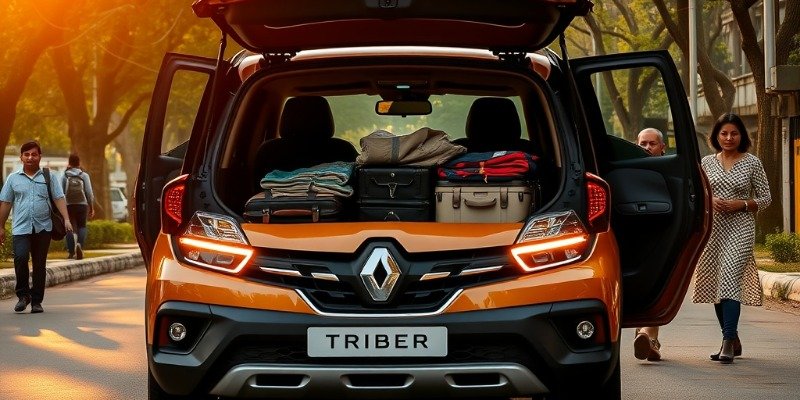
The Renault Triber has carved a unique space in the Indian market since its 2019 launch. It remains the only proper seven-seater you can buy for hatchback money, with prices starting at ₹5.81 lakh ex-showroom. While the SUV wave has reshaped buyer preferences, the Triber continues to find takers among large families and fleet operators who prioritise seat count and flexibility over high ground clearance. The 2025 facelift and a further Model Year 2026 update have kept the package fresh with a new grille, LED lighting, automatic climate control, and revised variant packaging. Yet the core proposition is unchanged: a sub-four-metre footprint that seats seven, a 1.0-litre naturally aspirated petrol engine, and a feature list that punches above its price.
Sales trajectory and market position
Renault sold 25,174 units of the Triber in FY26, according to CarDekho data, while CarBike360 records a rolling 12-month total of 24,123 units up to August 2026. The best year remains FY21 with 40,956 units, but volumes have tapered since. In August 2026 the model registered 1,536 units, down 17.9 percent year-on-year and 12.8 percent month-on-month. July 2024 had already shown a 19 percent YoY drop to 1,457 units. The decline coincides with the MPV segment heating up — Kia Carens, Maruti Ertiga, and Toyota Rumion all offer more space and stronger engines, albeit at higher prices. The Triber’s utility-vehicle market share slipped to 1 percent in FY25. Still, cumulative domestic sales have crossed 1.83 lakh units in six years, and the model accounts for nearly a third of Renault India’s volume.
Practicality that defines the segment
The Triber’s party trick is its EasyFlex seating. The third row can be folded or removed entirely, transforming the cabin from a seven-seater with 84 litres of boot space to a five-seater with 625 litres, or a two-seater load-lugger with 1,065 litres. Functional roof rails rated for 50 kg add another layer of utility. Second-row seats slide and recline, and the MY26 update brings one-touch tumble for easier third-row access. For a vehicle just 3,990 mm long, the interior feels airy thanks to a light-coloured dashboard and large windows. Third-row accommodation is realistic only for children or short hops; adults will find knee room tight even with the middle row slid forward.
Powertrain: adequate in town, strained on highways
Every Triber uses the same 999 cc Energy petrol engine producing 72 PS at 6,250 rpm and 96 Nm at 3,500 rpm. A five-speed manual is standard; a five-speed AMT is offered on the top-spec Emotion variant. In city traffic the drivetrain feels light and responsive enough, returning 11–12 kmpl in real-world conditions. Push hard or carry seven occupants and the engine turns noisy, overtakes need planning, and inclines demand momentum. Highway cruising at 80–90 kmpl is relaxed and can yield 17–18 kmpl. The AMT eases traffic fatigue but shifts slowly and adds a slight jerk. No turbo, diesel, or CNG factory option exists, though dealership-level CNG retrofits are available.
Variant walk-through: where the value sits
Seven variants span the range. The base Authentic (₹5.81 lakh) covers safety with six airbags, ESP, TPMS, and hill-start assist, but misses the touchscreen and rear AC vents. Evolution (₹6.74 lakh) adds the 8-inch screen with wired smartphone mirroring and second- and third-row vents. Techno (₹7.44 lakh) is the sweet spot — it brings automatic climate control, push-button start, rear camera, cooled glovebox, electrically folding ORVMs, 15-inch styled wheels, and height-adjustable driver seat. Emotion (₹8.05 lakh manual, ₹8.53 lakh AMT) adds auto LED projector headlamps, rain-sensing wipers, cruise control, wireless charger, 7-inch digital cluster, and leatherette seats. Dual-tone paint costs ₹16,000 extra on Emotion. Most buyers stop at Techno manual for the best feature-to-price balance.
Safety: six airbags standard, but crash-test scores diverge
Every Triber gets six airbags, ABS with EBD, ESP, traction control, hill-start assist, TPMS, rear sensors, ISOFIX anchors, and three-point belts all round. The pre-facelift model earned a four-star Global NCAP rating in 2021. Under the updated, more stringent 2024 protocol the same structure managed only two stars. The facelift has not been retested yet. Rivals like the Ertiga and Carens have since secured better scores under the new norms.
Features and cabin quality
The 2025 facelift introduced a floating 8-inch touchscreen with wireless Android Auto and Apple CarPlay, a 7-inch digital driver display, wireless phone charger, and a faux-wood dashboard strip. Automatic climate control arrived with the MY26 update. Missing items include a sunroof, branded audio, and ventilated seats — features now common in similarly priced SUVs. Plastics are scratchy but solid; the light fabric upholstery soils quickly. Second- and third-row passengers get dedicated AC vents, though fan controls are absent in the last row. Storage is abundant: twin gloveboxes (one cooled), bottle holders in all doors, seat-back pockets, and a cooled console bin.
Ride, handling, and NVH
The suspension is tuned for comfort. Potholes and speed-breakers are absorbed with a plush, controlled action even at full load. High-speed stability is decent; body roll exists but never feels alarming. Steering is light and predictable. The Achilles heel is NVH — the three-cylinder engine transmits vibration and noise into the cabin under load, and wind noise rises past 100 kmph. Insulation could be better for long-distance comfort.
Ownership costs and resale
ARAI mileage claims are 20 kmpl (manual) and 17 kmpl (AMT); real-world figures hover around 14–15 kmpl mixed. Service intervals are 10,000 km or one year. Spare-part availability and service network depth remain common complaints in owner reviews, though Renault has expanded touchpoints. Resale values are still being established for the facelift, but the pre-facelift model depreciated roughly in line with segment averages.
Competitors at a glance
The Nissan Gravite (₹5.73–9.38 lakh) is a badge-engineered twin with near-identical mechanicals and a slightly different feature split. Maruti Ertiga (₹8.90–13.14 lakh) and Toyota Rumion (₹9.79–14.21 lakh) offer significantly more space, a stronger 1.5-litre engine, and torque-converter automatic, but cost ₹3–5 lakh more. Kia Carens (₹11.12 lakh onwards) adds premium ambience and a turbo-petrol option at a higher price. Sub-compact SUVs like Tata Punch and Hyundai Exter provide SUV styling and better ground clearance but only five seats.
Final verdict
The Renault Triber survives because it solves a specific problem: seven seats in a sub-four-metre, sub-₹9-lakh package. No rival matches that combination. The 2025 facelift and MY26 updates have plugged feature gaps — automatic climate control, wireless connectivity, and better seat ergonomics — without raising the entry price. The 1.0-litre engine remains the weak link for loaded highway runs, and the two-star crash-test result under new norms is a concern. Yet for urban families, school runs, and occasional inter-city trips with modest luggage, the Triber delivers unmatched practicality per rupee. If your priority is maximum seats for minimum money, it still makes sense.