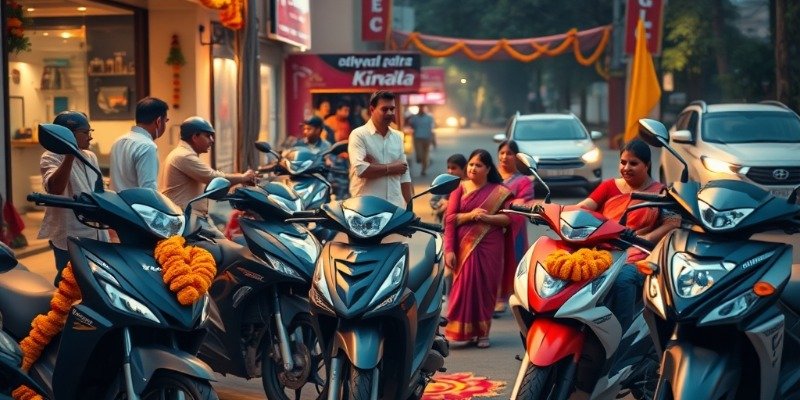
The festive season has always been a critical period for India's automobile industry. Recent data from multiple sources shows a clear pattern emerging: two-wheelers are consistently outperforming passenger vehicles during this crucial sales window. From Navratri to Diwali and the subsequent wedding season, motorcycles and scooters are posting stronger growth numbers while car sales face headwinds from high base effects and inventory challenges.
Navratri 2026 Numbers Tell the Story
FADA data for the nine-day Navratri period in 2026 reveals a striking contrast. Two-wheeler retail sales reached approximately 7.6 lakh units, growing 5.78 percent year-on-year. Passenger vehicles, meanwhile, declined 13.66 percent to about 1.72 lakh units. The overall automobile market grew a modest 1.95 percent to 10.32 lakh units, with two-wheelers accounting for nearly three-fourths of all vehicles sold.
An earlier Jefferies assessment comparing the opening festive week of October 2026 with the equivalent period in September 2025 showed even stronger two-wheeler momentum at 23 percent registration growth versus 7 percent for passenger vehicles. The two-year compound annual growth rate stands at 17 percent for two-wheelers against 10 percent for passenger vehicles during the festive opening week.
The 42-Day Festival Season Perspective
Business Standard reported FADA data for the 42-day festival season from Navratri to 15 days after Dhanteras (October 3 to November 13). Total retail sales hit 4.29 million units, up 12 percent from 3.84 million in the previous year. Two-wheelers led with 3.31 million units sold, a 14 percent increase from 2.91 million. Passenger vehicles grew 7.1 percent to 603,000 units from 563,000.
Notably, the rural share of two-wheeler sales increased from 53 percent to 56 percent in October alone, with FADA noting further pickup in November. In contrast, rural share for passenger vehicles, three-wheelers, and commercial vehicles remained flat at 61 percent, 52 percent, and 52 percent respectively.
Why Two-Wheelers Are Winning
PhilipCapital's sectoral update highlights several structural advantages. Two-wheeler discounts remain selective while passenger vehicle discounts are gradually declining. The benefits of GST cuts are more visible in two-wheelers due to lower ticket prices compared to passenger vehicles. Rural demand rebounded strongly in the last week of Diwali as farmers received payments from mandis, coinciding with the wedding season.
Affordability, daily commuting requirements, replacement purchases, and demand for practical personal mobility continue to drive two-wheeler sales. The segment also benefits from a lower base effect compared to passenger vehicles, which saw significant price reductions following GST changes in the previous festive season that pulled forward purchases.
Passenger Vehicle Challenges
The 13.66 percent decline in passenger vehicle retail sales during Navratri 2026 needs careful interpretation. FADA President Sai Giridhar cautioned against reading this as definitive evidence of weakening consumer demand. Three key factors complicate the comparison: an unusually high base from GST-driven purchases in 2025, elevated dealership inventory of approximately 45 days at the start of the festive season, and calendar misalignment between Navratri and Dussehra dates across the two years.
Passenger vehicle dealerships entered the season with high inventory financing costs, creating pressure for discounts. September 2026 had shown strong growth for both segments at 33.08 percent for two-wheelers and 32.10 percent for passenger vehicles, making the Navratri divergence even more notable.
OEM Performance Divergence
The two-wheeler market witnessed strong festive growth led by Hero MotoCorp, TVS Motor, and Royal Enfield, while Bajaj Auto lagged slightly behind. Hero MotoCorp reported over 40 percent year-on-year growth driven by popular commuter and 125cc models, supported by strong rural demand and wedding season momentum.
TVS Motor achieved around 35 percent growth with motorcycles like Raider and Apache outperforming scooters. Royal Enfield recorded 30-35 percent growth mainly from sub-350cc models, backed by brand loyalty, premium upgrades, and attractive financing.
Bajaj Auto's performance remained modest with low double-digit growth attributed to no new launches, absence of discounts, reduced advertising spend, and customer confusion from multiple sub-variants.
Inventory and Outlook
Two-wheeler inventory levels remain low to moderate, reflecting robust wholesale momentum. Passenger vehicle inventory, while improving, continues to remain above recommended levels. FADA expects passenger vehicle stock levels to reduce further as festivities conclude, with OEMs focusing on liquidating stock so dealers can enter the new year with the recommended 21 days of inventory.
PhilipCapital suggests retail optimism will continue until mid-December supported by strong festive demand. The upcoming wedding season, with approximately 3.8 million weddings between late November and mid-December, typically sees high vehicle sales especially in rural India. FADA also noted that small commercial vehicles staged a strong recovery while other commercial vehicle segments posted only marginal growth.
The complete picture will emerge only after the wider festive season including Diwali concludes, but current data clearly establishes two-wheelers as the growth leader in India's festive automobile market.
FAQs
Why are two-wheelers growing faster than passenger vehicles during the festive season?
Two-wheelers benefit from lower ticket prices making GST cuts more impactful, strong rural demand driven by farm payments and wedding season, selective discounting strategies, and underlying demand for affordable personal mobility and commuting needs.
Which two-wheeler companies performed best in the recent festive season?
Hero MotoCorp led with over 40 percent year-on-year growth, followed by TVS Motor at around 35 percent and Royal Enfield at 30-35 percent. Bajaj Auto lagged with low double-digit growth.
Is the passenger vehicle decline a sign of weak consumer demand?
FADA President Sai Giridhar cautioned against this interpretation. The decline reflects a high base from GST-driven purchases last year, elevated dealer inventory of 45 days, and calendar differences in festive dates. September showed strong 32 percent growth for passenger vehicles.
How important is rural demand for two-wheeler sales?
Rural demand is crucial. The rural share of two-wheeler sales increased from 53 percent to 56 percent in October and picked up further in November. Farmer payments from mandis coinciding with wedding season significantly boosted rural two-wheeler purchases.
What is the inventory situation for both segments?
Two-wheeler inventory remains low to moderate with robust wholesale momentum. Passenger vehicle inventory, while reducing, remains above the recommended 21 days, with FADA expecting further reduction by year-end as OEMs focus on stock liquidation.