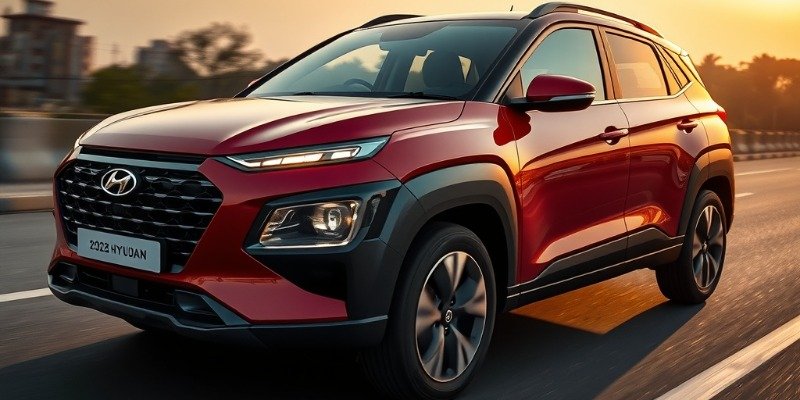
Hyundai Motor India is set to launch the Bayon SUV today, October 26, 2026. The new model slots between the Venue and the Creta in the company's SUV lineup. Bookings are already open for a token amount of Rs 11,000 through the official website and authorised dealerships. Deliveries are expected to begin during the festive season. The Bayon will compete in the mid-size SUV segment against rivals such as the Maruti Suzuki Victoris, Honda Elevate, Kia Seltos, and the Tata Sierra.
Design and exterior
The Bayon follows Hyundai's Art of Steel design language. The front fascia features a split headlamp arrangement. Slim LED daytime running lights run along the leading edge of the bonnet, while the main headlamp units sit lower in the bumper. Black and silver cladding adds contrast to the front design. The side profile shows pronounced wheel arches, sharp character lines, and petal-style alloy wheels. Blacked-out pillars create a floating-roof effect, while conventional pull-type door handles keep a familiar layout. At the rear, slim tail-lamp elements are connected visually by a black trim section with prominent Bayon lettering on the tailgate. A roof spoiler and dual-tone bumper complete the exterior design. The SUV measures 4,245 mm in length, 1,810 mm in width, and 1,605 mm in height with a 2,600 mm wheelbase. Ground clearance stands at 205 mm, and the boot offers 505 litres of space.
Interior and features
The cabin features a panoramic dashboard layout with two 12.3-inch displays. One serves as the instrument cluster and the other as the infotainment screen. The system runs Hyundai's Connected Car Navigation Cockpit accelerated by NVIDIA, with online navigation, split-screen functionality, personalised controls, and quick-access menus. A vertically oriented centre console and a dedicated climate-control panel are part of the layout. A key technology highlight is Hyundai Motor India's first generative AI voice assistant. It incorporates Perplexity's intelligence and voice AI technology from SoundHound AI. The system handles conversational requests related to weather, travel itineraries, hotels, restaurants, and nearby attractions. The Bayon also features Hyundai Bluelink with more than 70 connected functions, including remote vehicle controls, vehicle information, location-based services, and smartphone and smartwatch connectivity. Over-the-air updates will be supported for up to 19 vehicle controllers. The infotainment system and instrument cluster support 10 regional languages and two international languages. More than 500 embedded voice commands work in English, Hindi, Hinglish, Tamil, Bengali, and Telugu without an internet connection.
Engine and transmission
The Bayon is powered by a 1.5-litre, four-cylinder, naturally aspirated MPi petrol engine producing 115 PS and 144 Nm of torque. This engine is identical to the naturally aspirated petrol version used in the Hyundai Creta. Transmission options include a six-speed manual gearbox and Hyundai's Intelligent Variable Transmission (iVT), a continuously variable transmission. The iVT gets a Dash Boost Mode designed to improve responsiveness during overtaking. The SUV also features paddle shifters and Eco, Normal, and Sport drive modes to adjust powertrain response to different driving conditions. Hyundai has not announced a CNG variant for the Bayon at launch, though some reports suggest it may arrive later.
Safety features and ADAS
The Bayon is built on Hyundai's Global K Enhanced Platform. The body structure uses 69 percent advanced multi-grade high-strength steel, including hot-stamped steel. The structure incorporates reinforced load paths and ring-type construction designed to manage crash forces and reduce cabin intrusion. The SUV offers more than 80 advanced safety features, with over 35 available as standard across all variants. Standard equipment includes six airbags, electronic stability control, ABS with EBD, hill-start assist control, and rear parking sensors. The Hyundai SmartSense Level 2 Pro ADAS suite comprises 23 functions supported by three radars and 12 parking sensors. Key ADAS features include Forward Collision Warning, Forward Collision-Avoidance Assist, Blind-spot Collision Warning, Blind-spot Collision-Avoidance Assist, Lane Keeping Assist, Lane Departure Warning, Driver Attention Warning, and Safe Exit Warning. The system also includes assistance for junction-turning situations and encounters with oncoming traffic. Rear Cross-Traffic Collision Warning and Rear Cross-Traffic Collision-Avoidance Assist are provided for reversing manoeuvres. Highway assistance functions comprise Smart Cruise Control with Stop and Go, Lane Following Assist, Highway Driving Assist, High Beam Assist, and navigation-based Smart Cruise Control for curves and designated zones. Other equipment includes a Surround View Monitor, Blind-spot View Monitor, and front and rear parking sensors.
Variants and expected pricing
The Bayon will be offered in five trim levels: HX2, HX4, HX6, HX8, and HX10. The base HX2 variant comes with a six-speed manual gearbox and includes LED headlamps, a fully digital instrument cluster, steering-mounted controls, manual AC, tilt-adjustable steering, front and rear USB charging ports, and the standard safety suite with 35 features. The HX4 adds body-coloured ORVMs, matching door handles, a shark-fin antenna, a touchscreen infotainment system with wireless Apple CarPlay and Android Auto, electrically adjustable ORVMs, high-line TPMS, and a rear-view parking camera with dynamic guidelines. The HX6, available with both manual and IVT automatic, adds sporty alloy wheels, rear LED tail lamps, silver faux skid plates, single-zone automatic climate control with rear AC vents, smart keyless entry with push-button start, cruise control, auto-dimming electrochromic IRVM, rear window wiper, washer, and defogger. The HX8, also offered with both transmissions, adds 17-inch diamond-cut alloy wheels, H-Edge LED DRL light bar setup, dual 12.3-inch curved screen setup, single-pane sunroof, wireless smartphone charging, 360-degree Surround View Monitor, and Blind-Spot View Monitor. The top-spec HX10 comes only with the IVT automatic and adds dark chrome front grille accents, dual-tone roof finish, full H-Edge lighting signature, ventilated front seats, dual-tone interior theme with ambient cabin lighting, Bose premium audio system, front and rear factory dashcams, generative AI voice assistant, OTA software update support, panoramic sunroof, and the full Level 2 Pro ADAS suite with 23 active safety functions plus all-wheel disc brakes. Expected ex-showroom prices range from approximately Rs 9.5 lakh for the base HX2 to around Rs 15.5 lakh for the top-spec HX10. Official variant-wise pricing will be announced at the launch event today.
Competitors and market position
The Bayon enters a crowded mid-size SUV segment. It will compete directly with the Maruti Suzuki Victoris, Honda Elevate, Kia Seltos, Tata Sierra, Maruti Grand Vitara, Toyota Hyryder, Volkswagen Taigun, and Skoda Kushaq. Its positioning between the sub-four-metre Venue and the larger Creta creates a new sub-segment. The lack of diesel, turbo-petrol, or hybrid options at launch may limit its appeal to some buyers, but the feature-loaded cabin, proven engine, and aggressive pricing could make it a strong value proposition. The real test will be the final pricing announced today and how the SUV performs in real-world driving conditions.
The Hyundai Bayon brings a fresh design, a tech-heavy interior, and a comprehensive safety package to a competitive segment. Its success will depend on the final pricing Hyundai announces today and whether the feature list justifies the premium over the Venue while undercutting the Creta. The generative AI voice assistant and Level 2 Pro ADAS are segment-first features that could attract tech-savvy buyers. However, the absence of a diesel or turbo-petrol option means the Bayon relies entirely on its naturally aspirated petrol engine to cover a wide price band. Buyers should wait for the official price announcement and variant breakdown before making a decision.
FAQs
When is the Hyundai Bayon launching in India?
The Hyundai Bayon is launching in India today, October 26, 2026. Bookings have been open since September 2026 for a token amount of Rs 11,000. Deliveries are expected to begin during the festive season.
What is the expected price range of the Hyundai Bayon?
Expected ex-showroom prices range from approximately Rs 9.5 lakh for the base HX2 variant to around Rs 15.5 lakh for the top-spec HX10 variant. Different sources estimate slightly different ranges, but the official variant-wise pricing will be announced at the launch event today.
What engine and transmission options does the Bayon offer?
The Bayon comes with a 1.5-litre naturally aspirated petrol engine producing 115 PS and 144 Nm of torque. Transmission choices are a six-speed manual gearbox and a CVT automatic (marketed as iVT or IVT). There is no diesel, turbo-petrol, or CNG option at launch.
What are the key safety features in the Hyundai Bayon?
The Bayon offers more than 80 advanced safety features with over 35 standard across all variants. Standard features include six airbags, electronic stability control, ABS with EBD, hill-start assist, and rear parking sensors. The top variants get Level 2 Pro ADAS with 23 functions, three radars, 12 parking sensors, a 360-degree camera, blind-spot view monitor, and all-wheel disc brakes.
How many variants will the Hyundai Bayon have?
The Hyundai Bayon will be offered in five trim levels: HX2, HX4, HX6, HX8, and HX10. The base HX2 and mid-entry HX4 are manual-only. The HX6 and HX8 are available with both manual and IVT automatic transmissions. The top-spec HX10 comes only with the IVT automatic gearbox.