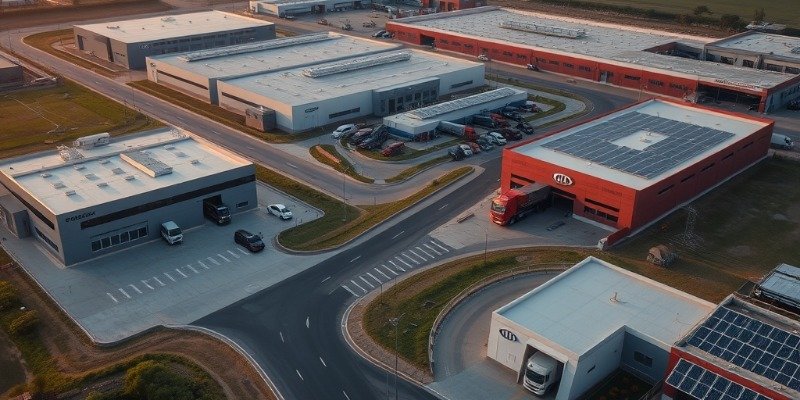
When Kia Motors first announced its entry into India in 2017, the company chose Andhra Pradesh over the traditional automotive hubs of Tamil Nadu and Maharashtra. That decision has since reshaped the southern manufacturing landscape. The South Korean automaker's initial $2 billion commitment built a 536-acre facility in Anantapur district that began mass production of the Seltos in July 2019. Today, that same plant stands at the center of a much larger industrial story.
The Anantapur facility currently operates with an installed capacity of three lakh units per year. Since inception, it has rolled out over 6.3 lakh vehicles, including more than 1.5 lakh units shipped to export markets. Models produced here include the Seltos, Sonet, Carens, and more recently the Syros — vehicles developed specifically for Indian conditions. The plant also serves as a CKD export hub, with over 100,000 kits dispatched by late 2024.
Now, Kia India is preparing to double down. A fresh $1.5 billion investment has been lined up to expand the Anantapur operations, with a formal announcement expected at the Andhra Pradesh Investor Summit in Visakhapatnam. This expansion will add a new production line, pushing potential annual capacity to approximately five lakh vehicles. The additional flexibility will allow Kia to introduce new models and diverse powertrain combinations, including electric variants, as customer preferences evolve.
This manufacturing push does not happen in isolation. Three major South Korean component suppliers — Hwashin, Seoyon, and Iwamet — have committed a combined Rs 1,614 crore to set up facilities near the Kia plant. Hwashin plans Rs 850 crore with 100 jobs, Seoyon Rs 514 crore with 918 jobs, and Iwamet Rs 250 crore with 400 jobs. Together, these investments create a localized supply chain that reduces import dependence and strengthens the region's automotive ecosystem.
Government policy has played a catalytic role. Andhra Pradesh's Industrial Development Policy 4.0 (2024-29) offers capital investment subsidies up to 15 percent for mega and ultra-mega projects, power-cost reimbursement of Rs 1 per unit for two years, 100 percent net SGST reimbursement for five years, and stamp duty and land-conversion charge reimbursements. The state's Sustainable Electric Mobility Policy 4.0 adds further incentives for EV, battery, and component manufacturers. These frameworks align with Kia's stated focus on evolving powertrain preferences.
Employment generation remains a core outcome. The original plant creation targeted 10,000 direct jobs and 3,000 operational roles, with joint training programs developed alongside the state government. The new expansion and ancillary investments add another 1,418 committed jobs from the three component suppliers alone. This multiplier effect extends to logistics, services, and township development across the 535.5 acres allocated for the main plant, 36 acres for housing, and 11.2 acres for a training centre.
Kia's global footprint currently spans 15 manufacturing facilities producing three million cars annually. The Andhra Pradesh leadership has openly stated its ambition to make the Anantapur plant Kia's largest production location worldwide. With the expanded capacity, deepening localization, and policy tailwinds, that goal moves closer to reality. The cluster forming around Anantapur now represents one of India's most significant greenfield automotive investments in recent years — a testament to how strategic location choices, backed by consistent policy support, can create new industrial geographies.
FAQs
What is Kia's total investment in Andhra Pradesh so far?
Kia's total committed investment in Andhra Pradesh now stands at $3.5 billion, combining the original $2 billion announced in 2018 with the new $1.5 billion expansion planned for the Anantapur facility.
How much will the Anantapur plant capacity increase after the expansion?
The expansion will raise the plant's annual production capacity from the current three lakh units to approximately five lakh vehicles per year.
Which component suppliers are investing near the Kia plant?
Three Korean suppliers — Hwashin (Rs 850 crore), Seoyon (Rs 514 crore), and Iwamet (Rs 250 crore) — have signed MoUs worth Rs 1,614 crore to set up facilities near the Anantapur plant.
What government policies support this manufacturing cluster?
Andhra Pradesh's Industrial Development Policy 4.0 and Sustainable Electric Mobility Policy 4.0 (both 2024-29) provide capital subsidies, power-cost reimbursements, SGST refunds, and stamp duty relief for eligible automotive and EV manufacturing projects.
What models are currently produced at the Anantapur facility?
The plant produces the Seltos, Sonet, Carens, and Syros for the domestic market, and has also dispatched over 100,000 CKD kits for export by November 2024.