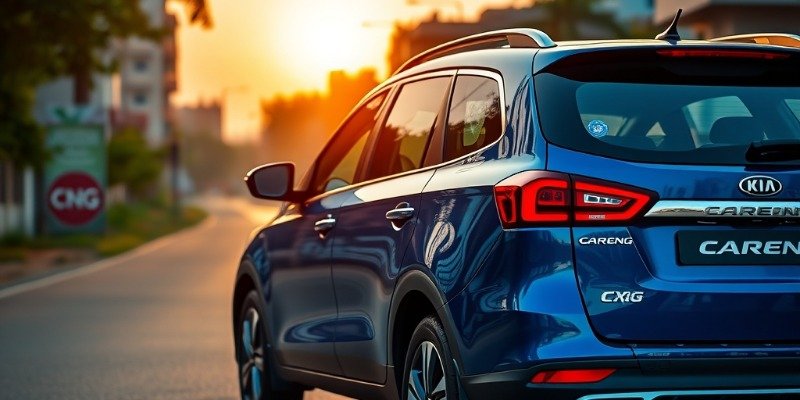
Kia India has finally brought a factory-fitted CNG option to its popular three-row MPV, the Carens. After months of spy shots and dealer-level retrofit solutions, the company announced prices for the Carens CNG on 22 September 2026. The move fills a clear gap in the lineup for buyers who want low running costs without giving up the space and comfort of a proper seven-seater. The Carens CNG is offered in a single Premium (O) trim with a six-speed manual gearbox, priced at Rs 12.12 lakh ex-showroom. This represents a premium of roughly Rs 99,000 over the equivalent petrol-manual variant.
Launch timeline and booking details
The road to launch began with official confirmation on 4 September 2026 that both the Carens and the newer Carens Clavis would receive a factory-fitted, under-floor CNG kit ahead of Diwali. Kia opened pre-bookings for the CNG versions on 11 September 2026, stating that both models would come with a 60-litre CNG tank. Prices were kept under wraps until the formal announcement on 22 September 2026, when the Carens CNG was revealed at Rs 12.12 lakh and the Carens Clavis CNG at Rs 12.39 lakh for the HTE variant and Rs 13.35 lakh for the HTE (O) variant. Deliveries are expected to commence shortly after the price announcement, aligning with the festive season timeline.
Powertrain and CNG specifications
The Carens CNG uses Kia's 1.5-litre naturally aspirated petrol engine. In CNG mode, the engine produces 95 bhp and 123 Nm of torque, paired exclusively with a six-speed manual transmission. The CNG system features a 60-litre tank integrated alongside the existing 45-litre petrol tank, giving the MPV a dual-fuel setup. Kia has made several engineering changes to accommodate the CNG kit, including modified suspension tuning for the added weight, CNG-specific engine calibration, 16-inch front disc brakes, a CNG fuel change switch, and a 4.2-inch colour TFT multi-information display with a CNG distance-to-empty readout. The third-row seat back frame has also been revised to improve its recline angle, and a spare tyre is retained despite the CNG tank placement.
Variant structure and feature highlights
As of 2026, the standard Carens range has been rationalised to a single Premium (O) trim, and the CNG follows the same approach. The Premium (O) CNG comes well-equipped for a family-focused buyer. Key features include an eight-inch touchscreen infotainment system with wired Android Auto and Apple CarPlay, a 12.5-inch LCD instrument cluster, reverse camera with guidelines, five USB Type-C charging ports across all three rows, tyre pressure monitoring system, and six airbags as standard. The variant rides on 15-inch steel wheels with covers. While it misses out on automatic transmission, ventilated seats, panoramic sunroof, and ADAS, the core safety and convenience package remains strong for the price.
Running cost advantage and real-world efficiency
The primary draw of the Carens CNG is the significant reduction in per-kilometre running cost compared to petrol or diesel variants. With a claimed efficiency of up to 15.58 km/kg in CNG mode and a combined tank range that can exceed 800 kilometres on a full fill of both fuels, the MPV becomes a compelling choice for families with predictable daily commutes and access to CNG refuelling infrastructure. The 60-litre CNG tank is among the largest in the segment, reducing the frequency of refuelling stops. For buyers who cover 1,500 to 2,000 kilometres a month, the payback period for the Rs 99,000 premium over the petrol variant can be as short as 18 to 24 months depending on local CNG and petrol prices.
Comparison with rivals
The most direct competitor is the Maruti Suzuki Ertiga CNG, which starts at a lower price point and offers a factory-fitted CNG option across multiple variants, including automatic variants in the broader Ertiga range. However, the Carens CNG counters with a larger 60-litre CNG tank versus the Ertiga's 55-litre unit, a longer wheelbase at 2,780 mm versus 2,740 mm, and a more spacious third row that can accommodate adults for short to medium trips. The Carens also offers six airbags as standard on the CNG trim, while the Ertiga CNG variants typically get two to four airbags depending on the grade. The Toyota Rumion CNG and Maruti XL6 CNG are other alternatives, though they are positioned at higher price points or with different seating layouts.
Safety and crash test performance
The Kia Carens was tested by Global NCAP in 2024 and received a three-star rating for adult occupant protection (22.07 out of 34) and a five-star rating for child occupant protection (41 out of 49). The structure was rated as stable, and the standard fitment of six airbags, ISOFIX mounts, electronic stability control, vehicle stability management, hill-start assist, and all-four disc brakes adds to the active safety net. The CNG variant retains all these safety features. While the adult protection score is adequate rather than class-leading, the strong child safety rating and comprehensive standard safety kit make it a responsible choice for family use.
Practicality and interior space
The Carens has always been praised for its genuinely usable third row, and the CNG variant does not compromise on this. With all three rows up, boot space stands at 216 litres, enough for a few school bags or a small suitcase. Folding the third row liberates 645 litres, and folding both second and third rows flat opens up 1,164 litres of cargo volume. The second-row seats slide and recline with a one-touch tumble function for easy third-row access. Roof-mounted AC vents for the second and third rows, multiple USB Type-C ports in every row, and a flat-folding third-row bench add to the everyday usability. The CNG tank is positioned under the boot floor, so there is no intrusion into the cabin space.
Ride and handling with CNG
The modified suspension tuning aims to offset the additional weight of the CNG tank, which is estimated at around 80 to 90 kilograms. In city driving, the Carens CNG remains compliant over broken roads and speed breakers, with the soft suspension setup absorbing sharp edges well. Steering is light and visibility is good, making the MPV easy to manoeuvre in tight urban spaces. On highways, the car settles into a relaxed cruising pace at 100 to 120 km/h. Body roll is noticeable during quick lane changes, but the electronic stability control intervenes smoothly. The 95 bhp output in CNG mode is sufficient for maintaining highway speeds with a full load, though overtakes require planning.
Ownership costs and warranty
Kia offers a standard warranty of three years or unlimited kilometres on the Carens. An extended warranty programme covering up to seven years is also available for both new and existing customers. Service intervals are set at 10,000 km or 12 months, with the first service free. Periodic maintenance costs for the diesel and petrol variants have been rated among the lowest in the segment by independent studies, and the CNG variant is expected to follow a similar trend. The CNG kit is factory-fitted, which means it is covered under the standard vehicle warranty, unlike aftermarket retrofit kits that often void warranty coverage on related components.
Who should consider the Carens CNG
The Carens CNG makes the most sense for families of five to seven who prioritise space, comfort, and low running costs over outright performance or premium features. It is ideal for buyers with a daily commute of 40 to 60 kilometres who have reliable access to CNG stations. The single Premium (O) trim simplifies the decision-making process, and the Rs 12.12 lakh ex-showroom price positions it competitively against the top-end Ertiga CNG variants while offering more third-row room and a larger CNG tank. Buyers who need an automatic transmission, ventilated seats, a sunroof, or ADAS will need to look at the Carens Clavis CNG or higher-segment MPVs like the Hyundai Alcazar.
The Kia Carens CNG arrives as a well-timed addition to the lineup, addressing a clear demand for a factory-fitted CNG three-row MPV with a spacious cabin and strong safety equipment. Its large CNG tank, competitive pricing, and retained practicality make it a sensible alternative in the family MPV segment.
FAQs
When was the Kia Carens CNG launched in India?
The Kia Carens CNG was officially launched on 22 September 2026, with prices announced at Rs 12.12 lakh ex-showroom for the Premium (O) variant. Bookings had opened on 11 September 2026.
What is the price difference between the Carens CNG and the petrol variant?
The Carens CNG Premium (O) commands a premium of approximately Rs 99,000 over the equivalent 1.5-litre petrol-manual Premium (O) variant, which is priced at Rs 11.12 lakh ex-showroom.
What engine and transmission does the Carens CNG use?
The Carens CNG uses a 1.5-litre naturally aspirated petrol engine that produces 95 bhp and 123 Nm in CNG mode. It is paired exclusively with a six-speed manual transmission. No automatic option is available.
How large is the CNG tank and what is the claimed efficiency?
The Carens CNG gets a 60-litre CNG tank integrated under the boot floor alongside the standard 45-litre petrol tank. The claimed efficiency in CNG mode is up to 15.58 km/kg.
Does the Carens CNG get the same safety features as the petrol variant?
Yes, the Carens CNG retains the full safety package of the Premium (O) trim, including six airbags, electronic stability control, vehicle stability management, hill-start assist, all-four disc brakes, ISOFIX mounts, and tyre pressure monitoring system.