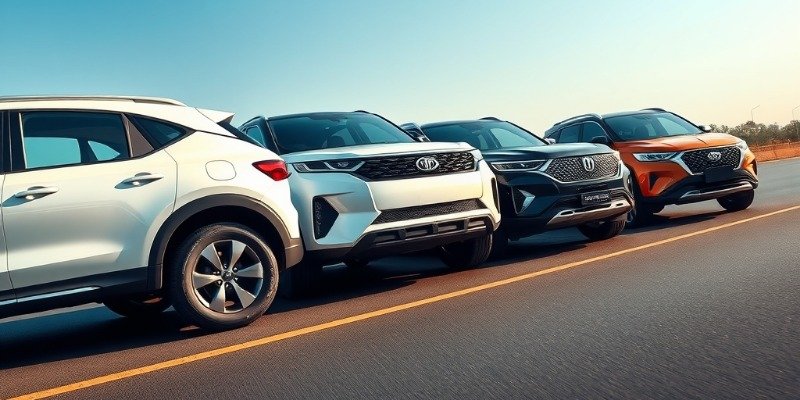
The full-size seven-seater SUV segment in India has a new contender. Kia has launched the Sorento at a starting ex-showroom price of Rs 27.99 lakh, undercutting both the MG Gloster at Rs 32.60 lakh and the Toyota Fortuner at Rs 35.11 lakh. This price gap of over Rs 7 lakh between the cheapest and the most expensive model sets the stage for a three-way fight where each SUV brings a different philosophy to the table.
The Sorento arrives as a modern monocoque SUV with a diesel engine and a dual-clutch automatic. The Gloster uses a traditional body-on-frame construction with a diesel engine and torque-converter automatic, though it has been phased out in favour of the newer Majestor. The Fortuner, the segment leader by reputation, sticks to a body-on-frame platform but offers only a petrol engine in its base 4×2 automatic variant. Buyers now have to weigh outright affordability, fuel efficiency, off-road ability, and long-term ownership costs against each other.
Price and running costs
On paper, the Sorento is the most affordable to buy. Its ex-showroom price of Rs 27.99 lakh is nearly Rs 5 lakh less than the Gloster and Rs 7.12 lakh less than the Fortuner. When on-road costs in Mumbai are considered, the Sorento comes to about Rs 34.07 lakh, the Gloster to Rs 39.50 lakh, and the Fortuner to Rs 42.05 lakh. Monthly EMIs for a five-year loan at 8 percent interest with 80 percent funding work out to roughly Rs 56,754 for the Sorento, Rs 66,097 for the Gloster, and Rs 71,190 for the Fortuner.
Fuel economy reinforces the Sorento's cost advantage. Its ARAI-claimed mileage of 17.66 kmpl is significantly higher than the Gloster's 13.9 kmpl and the Fortuner's 10.3 kmpl. Over long ownership periods, the diesel Sorento will cost less to run than the petrol Fortuner, while the Gloster sits in between. The Sorento also gets a 67-litre fuel tank, the Gloster a 75-litre unit, and the Fortuner an 80-litre tank, but the Sorento's efficiency gives it the longest theoretical range.
Engine, performance, and drivetrain
The Sorento uses a 2.2-litre four-cylinder diesel producing 190 bhp at 3800 rpm and 442 Nm of torque between 1750 and 2750 rpm. It drives the front wheels through an eight-speed dual-clutch automatic. The Gloster's 2.0-litre diesel makes 158 bhp at 4000 rpm and 373.5 Nm at 1500 rpm, sent to the rear wheels via an eight-speed torque-converter automatic. The Fortuner's 2.7-litre petrol engine delivers 164 bhp at 5200 rpm and 245 Nm at 4000 rpm, also driving the rear wheels through a six-speed torque-converter automatic.
In a straight line, the Sorento is the strongest performer on paper with the highest power and torque figures. Its front-wheel-drive layout and monocoque chassis make it lighter and more responsive in city traffic and on highways. The Gloster's rear-wheel-drive setup and body-on-frame construction favour stability under load and off-road traction, especially in four-wheel-drive variants, though the compared variant here is two-wheel-drive. The Fortuner's petrol engine feels less torquey at low revs, which can mean more gear shifts in traffic, but it offers a smoother, quieter refinement that some buyers prefer.
Dimensions, space, and practicality
The Gloster is the largest of the three. It measures 4985 mm long, 1926 mm wide, and 1867 mm tall with a 2950 mm wheelbase. The Sorento is 4815 mm long, 1900 mm wide, and 1785 mm tall with a 2815 mm wheelbase. The Fortuner is the shortest at 4795 mm long, 1855 mm wide, and 1835 mm tall with a 2745 mm wheelbase.
The Gloster's longer wheelbase translates to the most spacious third row and the best shoulder room across all three rows. It also offers a six-seat version with captain seats in the second row. The Sorento's monocoque body allows a flat floor and decent second-row space, but its third row is tighter and best suited for children or short trips. The Fortuner's third row is similarly cramped, and its high floor reduces headroom.
Boot space with all seats up tells a different story. The Gloster leads with 343 litres, the Fortuner offers 296 litres, and the Sorento provides only 179 litres measured up to the roof. Folding the rear rows expands the Sorento to 813 litres, which is competitive, but the Gloster remains the most practical for luggage with seven occupants on board.
Ride, handling, and off-road ability
The Sorento's monocoque construction and independent suspension front and rear give it a car-like ride. It feels composed over urban potholes, stable at highway speeds, and easy to park. The Gloster uses a body-on-frame chassis with independent front and multi-link rear suspension. It rides well for a ladder-frame SUV but transmits more vertical movement over sharp bumps. Its taller stance and longer wheelbase make it less agile in tight spaces. The Fortuner also uses a body-on-frame platform with double-wishbone front and four-link rear suspension. It has a reputation for soaking up rough roads but can feel bouncy on highways and requires more steering effort at low speeds.
Off the tarmac, the Gloster has the clear advantage. Its body-on-frame build, available four-wheel-drive system with a BorgWarner transfer case, rear differential lock, and multiple terrain modes make it a genuine off-roader. The Sorento offers all-wheel drive in higher variants but lacks low-range gearing and differential locks, limiting it to gravel, wet roads, and light trails. The Fortuner's four-wheel-drive variants are capable, but the base 4×2 petrol model compared here is not meant for serious off-roading.
Features, safety, and technology
All three SUVs are well equipped, but the Sorento brings the most modern technology package. It gets dual 12.3-inch displays for instruments and infotainment, a digital instrument cluster, wireless Apple CarPlay and Android Auto, a 360-degree camera, ventilated front seats, dual-zone climate control with rear vents on the B-pillars, a powered tailgate, and Level 2 ADAS features such as adaptive cruise control, lane-keeping assist, and blind-spot collision avoidance. It also offers seven airbags and an electric parking brake.
The Gloster counters with a 12.3-inch touchscreen, an 8-inch digital driver display, a dual-pane panoramic sunroof, three-zone climate control, massage and ventilated front seats, a 360-degree camera, automatic parking assist, and Level 1 ADAS with adaptive cruise control, forward collision warning, automatic emergency braking, and lane-departure warning. It gets six airbags.
The Fortuner's base variant uses an 8-inch touchscreen with wired smartphone connectivity, leather upholstery, ventilated front seats, dual-zone climate control, a powered tailgate, and seven airbags. It misses out on a digital instrument cluster, a panoramic sunroof, wireless charging, and any ADAS features in this variant. Its analogue-digital instrument cluster and hydraulic power steering feel dated compared to the fully digital clusters and electric steering in the rivals.
Ownership experience and resale value
The Fortuner holds the strongest position here. It has a proven track record spanning over a decade, a vast service network, and unmatched resale value in the used-car market. CarTrade lists over 1,000 used Fortuners with prices starting as low as Rs 2.4 lakh for older models, indicating deep market liquidity. The Gloster has been discontinued and replaced by the Majestor, which may affect long-term parts availability and resale, though 234 used units are already listed from around Rs 14.75 lakh. The Sorento is new to India, so its long-term reliability, service costs, and depreciation curve are unknown. Kia's network is extensive, but Sorento-specific parts and trained technicians will take time to scale up.
Warranty coverage is similar across the board at three years. The Sorento offers unlimited kilometres and an extension up to five years, while the Gloster and Fortuner are limited to 100,000 kilometres.
Which SUV should you choose
If your priority is the lowest purchase price, best fuel economy, modern cabin technology, advanced safety systems, and a refined daily driving experience, the Kia Sorento makes the strongest case. It is the only one with a strong-hybrid option expected later, a fully digital dashboard, and Level 2 ADAS. Its front-wheel-drive layout and monocoque body suit urban families who rarely venture off-road.
If you need maximum cabin space, a proper body-on-frame SUV with genuine off-road hardware, and are comfortable buying a discontinued model with good used-car availability, the MG Gloster remains a compelling option. Its size, captain-seat configuration, and terrain modes cater to large families who travel long distances on varied roads.
If brand reputation, long-term reliability, proven resale value, and a petrol engine with smooth refinement are your deciding factors, the Toyota Fortuner continues to be the default choice for many. Its higher price buys peace of mind and a dealer network that reaches every corner of the country, but the base variant lacks several features now considered standard in this segment.
FAQs
What is the price difference between the Kia Sorento and the Toyota Fortuner?
The Kia Sorento starts at Rs 27.99 lakh ex-showroom, while the Toyota Fortuner base variant starts at Rs 35.11 lakh. This makes the Sorento cheaper by Rs 7.12 lakh at ex-showroom prices. On-road in Mumbai, the gap widens to about Rs 8 lakh.
Which SUV offers the best mileage among the three?
The Kia Sorento returns the highest ARAI-claimed mileage at 17.66 kmpl. The MG Gloster is rated at 13.9 kmpl, and the Toyota Fortuner petrol at 10.3 kmpl. Real-world figures will vary, but the Sorento's diesel engine and lighter construction give it a consistent efficiency advantage.
Is the MG Gloster still being sold as a new car?
No, the MG Gloster has been phased out and replaced by the MG Majestor. New Gloster units may still be available as remaining dealer stock, but the model is no longer in active production. Buyers looking at the Gloster today will mostly be considering used examples.
Does the Kia Sorento have better off-road capability than the Fortuner?
The Sorento offers all-wheel drive in higher variants but uses a monocoque chassis without low-range gearing or locking differentials. The Fortuner's four-wheel-drive variants, built on a body-on-frame platform with low-range transfer case, are more capable off-road. The base Fortuner 4×2 petrol compared here has no off-road ability beyond gravel roads.
Which SUV has the highest resale value?
The Toyota Fortuner historically commands the highest resale value in this segment due to its brand reputation, durability, and strong demand in the used-car market. The Gloster's discontinuation may accelerate its depreciation, while the Sorento's resale performance is yet to be established.