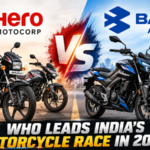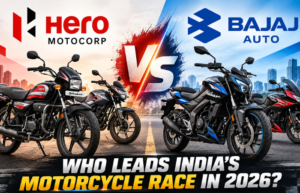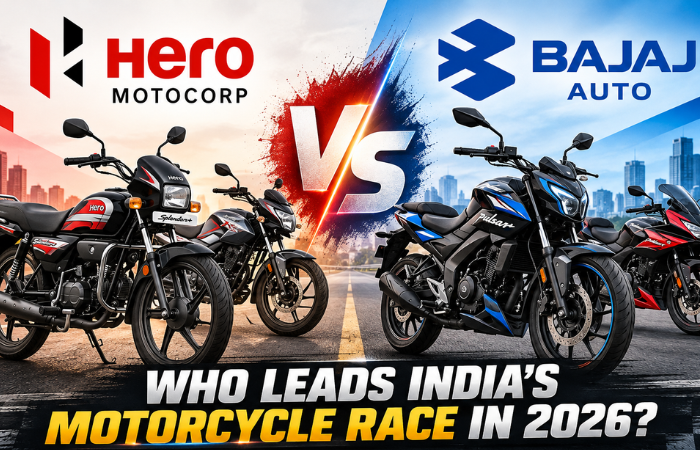
India's two-wheeler market entered 2026 with a clear leader but a rapidly changing competitive landscape. Hero MotoCorp remains the country's largest motorcycle maker by volume, yet its dominance has eroded steadily over the past four years. Bajaj Auto, once a close rival for the top spot, now sits in fourth place domestically while retaining its crown as India's leading two-wheeler exporter. The race between these two iconic brands tells a larger story of shifting consumer preferences, the rise of TVS Motor Company, and the quiet but steady advance of electric mobility.
Market Positions in Mid-2026
Retail sales data from May 2026 shows Hero MotoCorp holding first position with a 28.07 percent market share. Honda Motorcycle & Scooter India follows at 24.52 percent, while TVS Motor Company occupies third place at 19.32 percent. Bajaj Auto trails in fourth with 10.72 percent. The wholesale dispatch numbers for July 2026 paint a similar picture. Hero led with 5,01,403 units and a 26.07 percent share. Honda dispatched 4,76,436 units for 24.77 percent share. TVS recorded 4,37,394 units at 22.74 percent. Bajaj Auto dispatched 1,65,747 units for an 8.62 percent share. The gap between Hero and TVS has narrowed to just 3.33 percentage points, a dramatic compression from the double-digit leads of previous years.
Four-Year Trend: Erosion at the Top
Industry data tracking the period from December 2021 to February 2026 reveals the scale of the shift. Hero MotoCorp's market share fell from 34.5 percent to 26.92 percent, the sharpest decline among all major manufacturers. Bajaj Auto's domestic share slipped from 12.5 percent to 10.63 percent over the same window. Honda remained relatively stable, inching up from 24.8 percent to 25.36 percent. The standout gainer was TVS Motor Company, which grew from 15.15 percent to 19.64 percent. Suzuki, Royal Enfield, Yamaha, and Ather Energy also registered gains, though from smaller bases. The overall market expanded from roughly 15.3 million units in calendar year 2022 to over 20 million units in calendar year 2025, approaching the historic peak of 21 million units seen in 2018.
Product Portfolio and Volume Drivers
Hero's volumes continue to be anchored by its core commuter models, the Splendor and HF Deluxe. These motorcycles deliver consistent numbers but operate in a segment where differentiation is limited. The company's newer launches have struggled to scale meaningfully, which has limited its ability to offset share erosion in its traditional stronghold. Bajaj Auto's domestic portfolio is led by the Pulsar and Platina ranges. The Pulsar brand carries strong equity in the performance commuter space, while Platina serves the entry-level buyer. However, growth has been muted compared to peers, and the company's domestic market share has declined even as the overall market grew.
Export Strength vs Domestic Focus
A critical difference between the two companies lies in their geographic exposure. Bajaj Auto has long been India's leading two-wheeler exporter, and its international business continues to provide a buffer against domestic share losses. The company's global footprint spans over 70 countries, with motorcycles and three-wheelers contributing significantly to overall revenue. Hero MotoCorp, by contrast, remains heavily focused on the domestic market. While it has export operations, they represent a much smaller share of its total volumes. This makes Hero more vulnerable to domestic competitive pressures but also means its market share numbers are a more direct reflection of its performance in India.
The TVS Factor
Any discussion of Hero and Bajaj in 2026 is incomplete without acknowledging TVS Motor Company's rise. TVS grew its dispatches by 41.7 percent year-on-year in July 2026, the fastest among the top three players. Its Apache range, Radeon, Raider, and the iQube electric scooter have given it a presence across commuter, premium, and electric segments. The updated Jupiter scooter has also strengthened its scooter portfolio. TVS's gains have come at the expense of both Hero and Bajaj, particularly in the premium commuter space where margins are healthier. If current trajectories continue, TVS could challenge Honda for the second spot within the next 12 to 18 months.
Electric Transition and Its Impact
The shift toward electric two-wheelers is accelerating. In May 2026, electric two-wheelers accounted for 9.25 percent of retail sales, up from 6.11 percent a year earlier. Petrol two-wheelers fell to 90.68 percent from 93.67 percent. Ather Energy more than doubled its retail sales and reached 1.61 percent market share in July 2026 dispatches. Newer entrants like River posted triple-digit growth from a small base. Hero has invested in Ather Energy and launched its own Vida electric scooter. Bajaj has the Chetak electric scooter and its partnership with KTM for performance electric motorcycles. Both companies are playing catch-up in a segment where TVS, through the iQube, and pure-play EV makers have established early leads.
Challenges Ahead
Hero MotoCorp faces the challenge of revitalizing its product pipeline beyond the Splendor and HF Deluxe. Its premium and electric offerings need to gain traction to arrest share decline. The company's scale and dealer network remain formidable advantages, but they must translate into new growth vectors. Bajaj Auto's domestic challenge is twofold: reviving volume growth in a segment where TVS and Honda are aggressive, and managing the transition of its strong Pulsar brand into the electric era without diluting its performance image. Its export business provides stability, but domestic relevance is critical for brand equity and dealer morale.
Hero MotoCorp leads the motorcycle race in 2026 by a comfortable margin on volume and market share, but the trend lines favor the challengers. Bajaj Auto is no longer in direct contention for the top spot domestically, having been overtaken by both Honda and TVS. Its strength lies in exports and a focused performance portfolio. The real battle for the next phase of India's two-wheeler market will be between Hero's ability to defend its lead through new products, TVS's momentum across segments, and the pace at which electric two-wheelers reshape the commuter landscape.
FAQs
What is Hero MotoCorp's market share in 2026?
Hero MotoCorp held a retail market share of 28.07 percent in May 2026 and a wholesale dispatch share of 26.07 percent in July 2026, making it the largest two-wheeler manufacturer in India by volume.
Where does Bajaj Auto stand in the domestic market share rankings?
Bajaj Auto ranked fourth in domestic market share with 10.72 percent in May 2026 retail sales and 8.62 percent in July 2026 wholesale dispatches, behind Hero MotoCorp, Honda, and TVS Motor Company.
Has Hero MotoCorp's market share declined in recent years?
Yes, Hero MotoCorp's market share fell from 34.5 percent in December 2021 to 26.92 percent by February 2026, representing the sharpest decline among major two-wheeler manufacturers in that period.
How is Bajaj Auto performing in exports?
Bajaj Auto remains India's leading two-wheeler exporter, with a strong international presence across over 70 countries. Its export performance offsets domestic market share losses and contributes significantly to overall revenue.
Which company is gaining market share the fastest?
TVS Motor Company is the fastest gainer, increasing its share from 15.15 percent in December 2021 to 19.64 percent in February 2026, and recording 41.7 percent year-on-year dispatch growth in July 2026.