The global automotive market is undergoing a dramatic shift in 2026. Electric vehicle sales are accelerating in many regions while traditional internal combustion engine vehicles lose ground. The data from the first half of the year shows a clear pattern. Buyers are moving toward electrified powertrains, but the path differs sharply across major markets.
Global EV momentum builds through July
Benchmark Mineral Intelligence reported that 1.85 million electric vehicles were sold worldwide in July 2026. This brought the year-to-date total to 11.5 million units. The global figure represents a 9 percent increase compared to July 2025. Senior EV Analyst George Whitcombe noted that year-to-date growth has improved for several consecutive months after a turbulent start in both China and North America. The global market continues to be defined by strong regional divergence.
Europe leads with subsidy-driven growth
Europe posted the strongest performance among major regions. EV sales grew 33 percent year-on-year in July, pushing the year-to-date growth rate to 28 percent. The monthly volume dipped 17 percent month-on-month due to the typical summer holiday lull, but the underlying trend remains robust. Major markets showed exceptional gains. France recorded an 81 percent jump and hit a record 37 percent penetration rate. Germany and the United Kingdom grew 46 percent and 43 percent respectively. Analysts attribute this to the return of EV subsidy schemes across major European economies over the past 18 months. Spain launched its new Auto+ scheme in August with retrospective application from January 2026, offering up to EUR 4,500 per vehicle.
North America struggles after tax credit removal
The North American picture is markedly different. EV sales fell 27 percent year-on-year in July, leaving the region down 18 percent for the year to date. The United States drives this weakness. The federal EV tax credit of $7,500 expired at the end of September 2025. The US market had shown improvement in the second quarter, with the year-to-date decline narrowing from minus 33 percent to minus 24 percent. However, July brought a return to steep negative comparisons as current sales are measured against the pre-expiration surge. Canada has started allocating permits under a new agreement with China that allows lower tariffs on Chinese-made EVs, with a first-year quota of 49,000 units.
China shows recovery signs amid record exports
China's EV market contracted 5 percent year-on-year in July, an improvement from earlier months. The year-to-date decline now stands at 12 percent. Despite softer domestic sales, Chinese automakers shipped more than 500,000 NEV units overseas in July, setting another monthly export record. Manufacturers are increasingly targeting international markets to offset domestic headwinds. Penetration rates continue to climb. The total Chinese vehicle market is falling faster than EV sales, pushing the EV share above 50 percent for the year so far, with multiple months exceeding 60 percent.
US plug-in market finds a new floor
Data from Argonne National Laboratory shows that 108,385 plug-in vehicles were sold in the United States in September 2026. This comprised 90,213 battery electric vehicles and 18,172 plug-in hybrids. Together they captured 8.21 percent of all light-duty sales. The figure was down 40 percent from September 2025, but that month was inflated by buyers rushing to claim the expiring tax credit. The broader trend remains intact. Year-to-date plug-in sales reached 885,633 units. Cumulative US plug-in sales since 2010 now exceed 8.7 million vehicles. Pure internal combustion engine vehicles have stayed below 80 percent of the US market for more than two years. Combined hybrid, plug-in hybrid, and battery electric sales have held steady at about 23.8 percent for the past six months.
Hybrids emerge as the primary growth engine
JD Power and GlobalData data for July 2026 shows hybrid vehicles captured 15.9 percent of new retail sales, up 2.5 percentage points from a year earlier. Battery electric share fell to 7.0 percent, down 3.3 points. Hybrids are now outselling pure EVs by more than two to one on a share basis. In the first half of 2026, overall new vehicle sales fell 2.2 percent, yet hybrid volumes rose roughly 9 percent. EV sales dropped 27 percent in the first quarter before stabilizing in the second. The expiration of the federal tax credit is the single biggest catalyst. Rising fuel prices linked to Middle East volatility have also pushed buyers toward fuel-efficient options that do not require charging infrastructure. Automakers are adjusting lineups. Toyota RAV4, Camry, and the redesigned Jeep Cherokee are now offered exclusively as hybrids for the 2026 model year.
Automakers rewrite roadmaps as write-downs mount
The shift has triggered massive financial adjustments. Ford recorded a $19.5 billion write-down tied to its EV business and discontinued the all-electric F-150 Lightning. General Motors paused development of its next-generation electric trucks and SUVs after a $6 billion write-down. Industry-wide EV-related write-downs and investment cuts since 2025 exceed $60 billion. Toyota, which maintained a multi-powertrain strategy, commands roughly 43 percent of US hybrid sales. Honda holds about 16 percent. Companies that hedged across technologies are outperforming those that bet heavily on a pure EV transition.
Used EV demand signals enduring interest
While new EV sales cooled, used EV volumes surged nearly 30 percent year-on-year in some quarters of 2026. Prices for used EVs are now within roughly $1,300 of comparable gasoline vehicles. This suggests real demand exists at the right price point. Tesla still holds about 45 percent of the new EV market, down from 49 percent two years ago. Toyota and Subaru have roughly doubled their EV volumes year-on-year even as the broader market contracted.
Global growth story extends beyond traditional markets
The International Energy Agency reports that global EV sales rose 35 percent in the second quarter compared to the first. Fifty countries posted their highest-ever quarterly totals, and more than 90 recorded year-on-year growth in the first half. Markets including Australia, Brazil, India, South Korea, and Vietnam roughly doubled their EV sales. Fuel price volatility, expanding charging networks, and a growing supply of affordable models are driving adoption. The IEA has raised its 2026 forecast to 29 percent global EV penetration, up from 28 percent projected in May. China is expected to exceed 60 percent of new car sales.
India rides the global wave
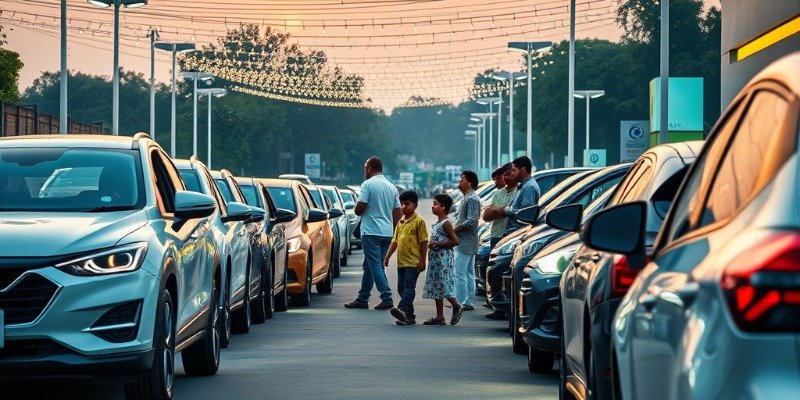
India's inclusion in the list of markets doubling EV volumes highlights the country's accelerating transition. Festive season buying typically amplifies this trend as consumers take advantage of promotional offers and new model launches. The growing presence of electric two-wheelers and passenger cars from domestic and international brands is widening choice. Local manufacturing incentives and state-level subsidies are further reducing the upfront cost gap.
The festive season has indeed flipped the script. While pure EV growth faces near-term headwinds in some major markets, the broader electrification trend — spanning hybrids, plug-in hybrids, and battery electrics — continues to gain structural momentum worldwide. The data does not support claims that electric drive technology is fading. Instead, it shows a market recalibrating around affordability, infrastructure readiness, and consumer preference for flexible electrified solutions.
FAQs
What was the global EV sales figure in July 2026?
Global EV sales reached 1.85 million units in July 2026, bringing the year-to-date total to 11.5 million units.
Why did US EV sales decline sharply in 2026?
The federal $7,500 EV tax credit expired on September 30, 2025, removing a major purchase incentive and effectively raising transaction prices for many buyers.
How are hybrids performing compared to pure EVs in the US?
In July 2026, hybrids captured 15.9 percent of new retail sales versus 7.0 percent for battery electric vehicles, meaning hybrids outsell EVs by more than two to one.
Which automakers have taken the largest financial hits from the EV slowdown?
Ford recorded a $19.5 billion write-down and discontinued the electric F-150 Lightning, while General Motors took a $6 billion write-down and paused next-generation electric truck development.
What is the outlook for global EV penetration in 2026?
The International Energy Agency now expects EVs to account for 29 percent of global car sales in 2026, with China projected to exceed 60 percent penetration.