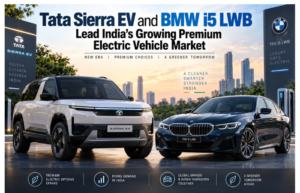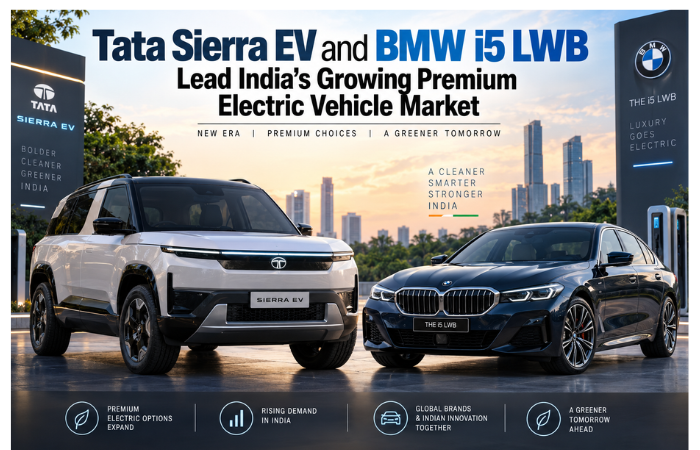
India's electric vehicle market is entering a new phase. After years of steady but modest growth, automakers are now launching premium electric models that challenge traditional price expectations. Two recent launches illustrate this shift clearly. Tata Motors has introduced the Sierra EV at a starting price of Rs 18.79 lakh, while BMW has begun local assembly of the i5 Long Wheelbase sedan at Rs 79.6 lakh. Both vehicles represent different ends of the premium spectrum, yet each is priced to compete directly with internal combustion alternatives.
The Tata Sierra EV marks the homegrown brand's most ambitious electric SUV to date. It sits at the top of Tata's current EV lineup, which spans from the Tiago EV to the Harrier EV. The Sierra EV uses the company's Acti.ev architecture and offers two battery pack options. The claimed range reaches up to 665 kilometres on a full charge, with an all-wheel-drive variant available. Deliveries began in mid-July 2026. On-road prices across major Indian cities fall between Rs 19.35 lakh and Rs 27.27 lakh depending on the variant.
Design cues reference the original Sierra from the 1990s, including the distinctive wraparound rear glass area. Modern elements include a closed front grille, connected LED light bars, and flush door handles. Inside, a three-screen dashboard layout, panoramic sunroof, ventilated front seats, and advanced driver assistance systems create a premium cabin experience. Tata expects the Sierra EV to achieve a 30 to 40 percent electric mix within the Sierra nameplate, similar to what the Harrier EV has achieved.
At the luxury end, BMW's i5 LWB represents a milestone as the company's first locally assembled electric sedan in India. Produced at the Chennai plant, the i5L eDrive35 avoids heavy import duties, allowing BMW to price it just Rs 3 lakh above the standard 5 Series Long Wheelbase petrol model at Rs 76.6 lakh. More significantly, it undercuts the Mercedes-Benz E200 LWB, which retails at approximately Rs 81.5 lakh. This pricing structure rewrites the cost equation for executive buyers who previously faced a steep premium for electric luxury vehicles.
The i5 LWB delivers a claimed range of 669 kilometres. With the long-wheelbase platform, rear-seat comfort remains a priority for chauffeur-driven buyers. Local production also ensures better parts availability and faster service turnaround. States offering road tax exemptions for electric vehicles will see the on-road price drop even closer to petrol rivals. BMW's move is expected to pressure other luxury brands to accelerate their local EV assembly plans.
Tata Passenger Electric Mobility reports a structural shift in demand. Enquiries and bookings across its EV portfolio have tripled over the past quarter. Vivek Srivatsa, Chief Commercial Officer at Tata Passenger Electric Mobility, describes this as a sustained change rather than a temporary spike. The company has sold over 300,000 electric vehicles cumulatively, while the industry fleet exceeds 400,000 units. This growing base of experienced EV owners is helping shift perceptions through first-hand ownership experience rather than second-hand opinions.
The mid-size SUV segment, where the Sierra EV competes, accounts for nearly 30 percent of all SUV sales in India. With SUVs making up roughly 60 percent of the passenger vehicle market, this segment represents the single largest volume opportunity. Rivals include the Mahindra BE 6 priced between Rs 18.90 lakh and Rs 27.79 lakh, the Hyundai Creta Electric between Rs 18.02 lakh and Rs 25.22 lakh, and the upcoming Maruti eVitara. Tata's strategy of offering both petrol and electric versions of the Sierra mirrors its approach with the Punch and Nexon, allowing buyers to choose their preferred powertrain within a familiar model range.
For luxury sedan buyers, the i5 LWB's arrival at a price below its key petrol rival marks a turning point. The traditional premium for electric drivetrains in the luxury segment has effectively disappeared for this model. Combined with a 669-kilometre range that addresses long-distance concerns, the i5 LWB removes two major barriers that previously kept executive buyers in petrol vehicles. Industry observers expect other German luxury brands to follow with locally assembled electric models in the coming years.
Production capacity remains a constraint for some popular EV models. Tata acknowledges that demand for the Punch EV continues to outstrip supply by nearly half for certain variants. The company expects overall passenger EV penetration to exceed 12 percent in the current financial year, supported by a steady pipeline of new launches across brands. Whether the current surge in enquiries translates to sustained retail growth will depend on charging infrastructure expansion, continued battery cost reductions, and manufacturers' ability to scale production.
The Sierra EV and i5 LWB represent two distinct but complementary developments. One brings premium electric mobility to a broader audience at mainstream prices. The other proves that luxury electric vehicles can now be priced at parity with petrol equivalents. Together, they signal that India's premium EV market is no longer a niche — it is becoming a mainstream choice across price segments.
FAQs
What is the starting price of the Tata Sierra EV in India?
The Tata Sierra EV starts at Rs 18.79 lakh ex-showroom. On-road prices in major cities range from Rs 19.35 lakh to Rs 27.27 lakh depending on the variant and location.
What is the claimed range of the Tata Sierra EV?
The Tata Sierra EV offers a claimed range of up to 665 kilometres on a full charge with the larger battery pack option.
How much does the BMW i5 LWB cost in India?
The locally assembled BMW i5 Long Wheelbase (i5L eDrive35) is priced at Rs 79.6 lakh ex-showroom.
Where is the BMW i5 LWB manufactured?
The BMW i5 LWB is produced at the BMW Group Plant in Chennai, making it the brand's first locally assembled electric sedan in India.
Which vehicles compete with the Tata Sierra EV in the mid-size electric SUV segment?
Key rivals include the Mahindra BE 6, Hyundai Creta Electric, MG Hector Tomahawk, and the upcoming Maruti eVitara.