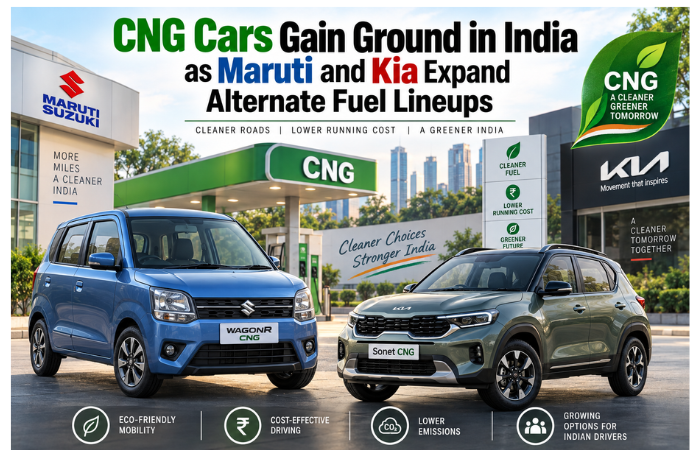
For the first time in India's passenger vehicle market, alternative fuel vehicles have outsold petrol-only cars. In August 2026, CNG, hybrid, and electric vehicles together captured 41.95 percent of retail sales, edging past petrol's 40.85 percent share. The milestone comes as major manufacturers widen their powertrain offerings and adoption spreads to new regions.
Market milestone reached in August 2026
Data from the Federation of Automobile Dealers Associations analysed by Forbes India shows that about 1.7 lakh alternative fuel passenger vehicles were sold in August 2026. This represents a 38 percent year-on-year increase, outpacing overall passenger vehicle growth of 16 percent in the same month. The alternative fuel category combines CNG and LPG models, strong hybrids, and battery electric vehicles.
FADA noted that the strong year-on-year comparison rests partly on a soft base in August 2025, when buyers deferred purchases ahead of an expected GST rate change. The federation added that the real test will be showroom conversions through the festive season from September to November.
Adoption spreading beyond traditional strongholds
The top five states of Maharashtra, Uttar Pradesh, Gujarat, Haryana, and Karnataka have long anchored alternative fuel sales. Their combined share fell from 59.9 percent in August 2025 to 53.7 percent in August 2026. Meanwhile, the rest of the country grew from 40.1 percent to 46.3 percent, a swing of over six percentage points in one year.
Tamil Nadu recorded the sharpest gain, rising from 4.8 percent to 6.5 percent of national alternative fuel volumes. Delhi moved from 5.2 percent to 6.5 percent. Andhra Pradesh, though smaller, grew from 1.4 percent to 2.1 percent. Traditional leaders retreated, with Maharashtra shedding 3.5 percentage points to 16.3 percent, Gujarat down 1.4 points to 10.9 percent, and Karnataka slipping one point to 6.7 percent.
Maruti Suzuki pursues multi-pathway strategy
Maruti Suzuki is scaling several technologies simultaneously. The company is rolling out strong hybrids such as the Grand Vitara and Invicto, developing flex-fuel vehicles, expanding its CNG range, and preparing electric models. This approach aims to avoid betting on a single future powertrain.
The automaker plans to introduce seven new SUVs over the next five to six years. SUVs now account for more than half of India's passenger vehicle market. Maruti is also working on a new entry-level model for first-time buyers while positioning hybrid SUVs in higher segments and using CNG and flex-fuel for cost-sensitive customers. The strategy mirrors parent Suzuki Motor Corporation's mid-term roadmap for India covering flex-fuel, CNG, and EVs.
Kia India readies EV, hybrid, and CNG models
Kia India is preparing to launch electric vehicles, hybrids, and CNG models together. Managing director Gwanggu Lee described the challenge of predicting customer preferences as a "huge burden" on carmakers. Unlike Europe where EVs lead or the US where hybrids have traction, India is seeing demand develop across multiple powertrains at once.
Strong CNG sales caught Kia by surprise, highlighting how quickly preferences can shift. CNG now accounts for more than 20 percent of cars sold in India, making it the second-largest powertrain segment. Kia will enter the CNG market with the Carens and Carens Clavis models. The newly launched Sorento three-row SUV offers hybrid petrol and diesel variants priced between ₹27.99 lakh and ₹40.4 lakh. Lee expects the Sorento hybrid to contribute over 60 percent of that model's sales, noting premium buyers may absorb the higher upfront cost.
Kia plans a Seltos hybrid for 2027 and has showcased a Carnival hybrid minivan. The company targets 410,000 annual sales in India by 2030, with eight of ten planned new models electrified. It expects electrified vehicles including EVs and hybrids to exceed 30 percent of its sales by the turn of the decade. EV capacity is being expanded after the Syros EV response exceeded expectations, though Lee emphasised affordability will dictate mass-market penetration speed.
Final verdict
India's passenger vehicle market has reached a turning point where alternative fuels collectively lead petrol for the first time. The shift is no longer confined to a few large states but is broadening across the country. Maruti Suzuki and Kia are both pursuing multi-powertrain strategies covering CNG, hybrids, flex-fuel, and EVs, reflecting the uncertain pace of electrification and the continuing strength of CNG as a bridge technology. Affordability remains the key factor that will determine how quickly electrified powertrains penetrate the mass market.
FAQs
What was the alternative fuel market share in August 2026
Alternative fuel vehicles including CNG, hybrids, and EVs captured 41.95 percent of retail passenger vehicle sales in August 2026, compared to petrol's 40.85 percent share.
Which states are driving the spread of alternative fuel adoption
Tamil Nadu, Delhi, and Andhra Pradesh showed the largest share gains in August 2026 versus the previous year, while the traditional top five states of Maharashtra, Uttar Pradesh, Gujarat, Haryana, and Karnataka saw their combined share decline.
What is Maruti Suzuki's alternative fuel strategy
Maruti Suzuki is pursuing a multi-pathway approach covering strong hybrids like the Grand Vitara and Invicto, flex-fuel vehicles, CNG models, and upcoming EVs, alongside plans for seven new SUVs and a new entry-level car.
What CNG models is Kia India planning to launch
Kia India will enter the CNG segment with the Carens and Carens Clavis models as part of its broader multi-powertrain rollout.
How large is the CNG segment in India currently
CNG accounts for more than 20 percent of passenger vehicles sold in India, making it the second-largest powertrain segment after petrol.