Renault is preparing its most ambitious product offensive for India in over a decade. After the new Duster arrives in 2026, the French automaker will launch two important SUVs in 2027. The Bigster will be a three-row C-segment SUV, while the Bridger will sit in the sub-4-metre compact SUV space. Both models will use the Renault Group Modular Platform (RGMP) that supports petrol, hybrid, and electric powertrains. This platform also underpins the upcoming Duster for India. Renault has taken full control of its Chennai manufacturing plant from the Renault-Nissan alliance, signalling a long-term commitment to the Indian market.
The Renault Bridger compact SUV
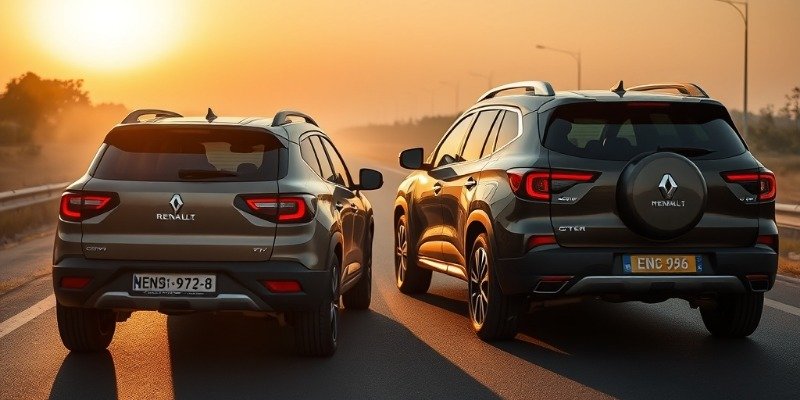
The Bridger concept was unveiled recently as a sub-4-metre SUV designed specifically for India and export markets. It will bridge the gap between the Kiger and the new Duster. The concept shows a rugged design with an upright stance, squared lines, strong shoulder line, and a tailgate-mounted spare wheel. This styling sets it apart from current rivals such as the Hyundai Venue, Kia Sonet, Kia Syros, Skoda Kylaq, and Maruti Suzuki Brezza.
The production Bridger will ride on 18-inch alloy wheels, offer 200 mm of ground clearance, and provide a 400-litre boot. Renault claims it will be among the most spacious vehicles in its segment. The powertrain line-up is expected to be diverse. A 1.2-litre naturally aspirated petrol engine will serve as the base option. A turbocharged petrol unit will cater to buyers wanting stronger performance. A strong-hybrid variant will target high mileage. An all-electric version will come with two battery options, likely 35 kWh and 55 kWh packs. The Bridger will be Renault's first fully electric model under its own brand in India, though it will launch first with the petrol engine.
The Renault Bigster seven-seater
The Bigster made its global debut as the Dacia Bigster at the 2024 Paris Motor Show. For India, it will arrive as a seven-seater version, unlike the five-seater sold internationally. The SUV measures 4.57 metres in length, 1.81 metres in width, and 1.71 metres in height with a 2.7-metre wheelbase. It rides on 19-inch alloy wheels and features dual-tone paintwork.
Inside, the Bigster gets an electric tailgate, panoramic sunroof, wireless phone charging, electrically adjustable driver's seat, 10-inch digital driver's display, 10.1-inch touchscreen infotainment, and dual-zone climate control. Safety includes Level 2 ADAS with adaptive cruise control, lane assist, automatic high beam, autonomous emergency braking, and blind spot monitoring.
Globally, the Bigster uses a Hybrid 155 system combining a 1.2-litre three-cylinder turbo petrol engine with a mild-hybrid setup and a six-speed manual gearbox. Front-wheel drive is standard with optional four-wheel drive. The 4WD version retains three pedals and offers hill descent control with multiple drive modes including Snow, Mud/Sand, Normal, Off-Road, and Eco. An LPG version called Eco-G 140 delivers a claimed range of 1,450 km with a combined 99-litre fuel capacity. For India, the Bigster is expected to feature a 1.3-litre four-cylinder turbocharged petrol engine. The CMF-B platform will be heavily localised to keep pricing competitive.
Platform and manufacturing strategy
Both SUVs are built on the Renault Group Modular Platform (RGMP). This architecture is developed for markets like India and supports internal combustion, hybrid, and battery-electric powertrains in the same vehicle family. The platform allows Renault to offer multiple energy options without developing separate architectures. Production of the Bridger is planned at the Chennai facility before expanding to other markets. This approach makes India a development and export hub for Renault's global strategy.
Market positioning and rivals
The Bridger will compete in the premium compact SUV segment, one of the most crowded spaces in India. Its rugged styling and multi-energy powertrain range could help it stand out. The Bigster will target the growing three-row SUV segment, rivalling models like the Tata Safari, Mahindra XUV700, and Hyundai Alcazar. With the Kwid, Kiger, Bridger, new Duster, and Bigster, Renault will cover price points from around Rs 4 lakh to nearly Rs 30 lakh. This complete portfolio marks a shift from the brand's previous sporadic launches.
Timeline and roadmap
The new Duster launches in 2026. The Bridger and Bigster follow in 2027. These are part of seven planned launches by 2030. Renault's CEO Fabrice Cambolive has stated that India will be at the heart of the Bridger's development. The company's "futurReady" strategy identifies India as a key hub for new platforms and models developed on RGMP for domestic sales and export.
Renault's upcoming launches show a clear and sustained product plan. The combination of rugged design, platform flexibility, and multiple powertrain choices gives the Bigster and Bridger a strong foundation. If pricing is competitive and localisation is deep, both SUVs could strengthen Renault's position significantly in their respective segments.
FAQs
When will the Renault Bridger and Bigster launch in India
Both SUVs are expected to launch in 2027. The new Duster will arrive first in 2026.
What powertrain options will the Renault Bridger offer
The Bridger will be offered with a 1.2-litre naturally aspirated petrol, a turbocharged petrol, a strong-hybrid, and an all-electric version with two battery pack choices.
Will the Renault Bigster be a seven-seater in India
Yes, the India-spec Bigster will be a three-row seven-seater, unlike the global five-seater version.
What platform do the Bigster and Bridger use
Both models use the Renault Group Modular Platform (RGMP) which supports petrol, hybrid, and electric powertrains.
Where will these SUVs be manufactured
Production is planned at Renault's Chennai plant, which the company now fully owns after taking over the joint venture with Nissan.