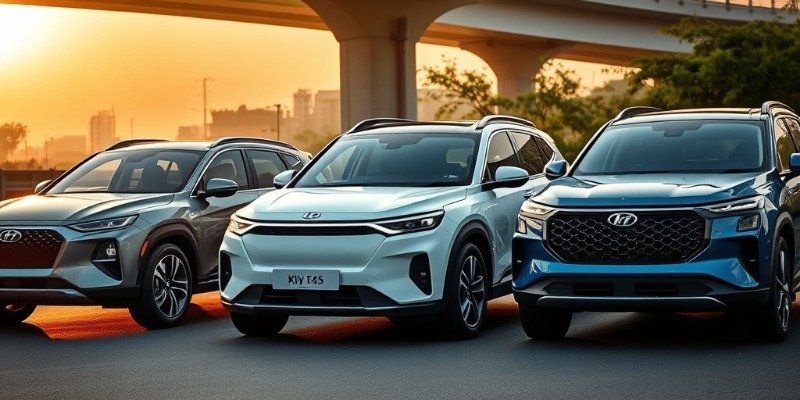
The premium electric SUV space is heating up for 2026 with three distinct contenders from Korea and China. The Hyundai Ioniq 5, Kia EV5, and BYD Atto 3 each bring different philosophies to the segment, built on dedicated EV platforms with unique battery technologies and drivetrain layouts. For Indian buyers tracking global launches, understanding how these models compare on paper helps set expectations for when they eventually arrive locally.
Design and Dimensions
All three vehicles seat five passengers across five doors, but their proportions differ noticeably. The Hyundai Ioniq 5 Limited AWD measures 4,656 mm in length with a 3,000 mm wheelbase, making it the longest and most spacious in terms of wheelbase. The Kia EV5 81.4 kWh FWD sits slightly shorter at 4,610 mm with a 2,750 mm wheelbase, while the BYD Atto 3 EVO Excellence AWD is the most compact at 4,455 mm length and 2,720 mm wheelbase.
Width follows a similar order: Ioniq 5 at 1,890 mm, EV5 at 1,875 mm, and Atto 3 at 1,875 mm (with folded mirrors). Height varies with the EV5 standing tallest at 1,675 mm, followed by Atto 3 at 1,615 mm and Ioniq 5 at 1,600 mm. Ground clearance favors the EV5 at 167 mm, ahead of Ioniq 5 at 155 mm, while Atto 3 data is not specified in the 2026 comparison.
Curb weight reflects battery size and drivetrain complexity. The Ioniq 5 Limited AWD weighs 2,180 kg, the EV5 FWD comes in at 2,069 kg, and the Atto 3 AWD is lightest at 1,990 kg. All three use steel-aluminum construction, with the Ioniq 5 employing advanced high-strength steel.
Boot space highlights the Ioniq 5's packaging advantage from its long wheelbase. It offers 745 litres with seats up and 1,655 litres maximum. The EV5 provides 566 litres and 1,650 litres respectively, while the Atto 3 manages 490 litres and 1,360 litres. The Ioniq 5 also has a 24-litre frunk, the EV5 a 44.4-litre front trunk, and the Atto 3 a 101-litre secondary trunk.
Performance and Powertrain
The drivetrain layouts create clear performance tiers. The Hyundai Ioniq 5 Limited AWD uses dual permanent magnet synchronous motors (rear 165 kW, front 74 kW) delivering 239 kW (320.5 hp) and 605 Nm combined. The Kia EV5 81.4 kWh FWD relies on a single front motor producing 160 kW (214.6 hp) and 295 Nm. The BYD Atto 3 EVO Excellence AWD deploys dual motors (rear 230 kW, front 100 kW induction) for 330 kW (442.5 hp) and 560 Nm total.
Acceleration times reflect these outputs. The Atto 3 sprints 0-100 km/h in 3.90 seconds, the Ioniq 5 manages 5.30 seconds, and the EV5 takes 8.40 seconds. Top speeds are 200 km/h (Atto 3), 185 km/h (Ioniq 5), and 165 km/h (EV5). All use single-speed reduction gear transmissions with regenerative braking.
The Ioniq 5 and EV5 share Hyundai-Kia's Electric-Global Modular Platform (E-GMP), while the Atto 3 runs on BYD's e-Platform 3.0. Suspension is MacPherson strut front across the board, with multi-link rear for Ioniq 5 and Atto 3, and a 4-link setup for EV5.
Battery, Range and Charging
Battery chemistry divides the trio. The Ioniq 5 Limited AWD uses an 84 kWh NMC pack (Hyundai Mobis) at 697V. The EV5 employs an 81.4 kWh LFP battery at 343V. The Atto 3 fits a 74.8 kWh BYD Blade LFP pack at 499.2V. LFP chemistry in the EV5 and Atto 3 allows regular 100% charging without degradation concerns, unlike the Ioniq 5's NMC pack which prefers 80% daily limits.
Range figures use different test cycles. The Ioniq 5 quotes 432.9 km EPA combined. The EV5 shows three WLTP combined figures: 505 km, 520 km, and 530 km. The Atto 3 lists 470 km WLTP combined. Real-world range will vary by climate, speed, and load.
Charging capability is a key differentiator. The Ioniq 5's 800V architecture supports 250 kW DC fast charging (10-80% in 20 minutes) and 10.9 kW AC. The EV5's 400V system handles 128 kW DC (10-80% in 30 minutes) and 11 kW AC. The Atto 3's 800V-compatible Blade battery accepts 220 kW DC (10-80% in 25 minutes) and 11 kW AC. All three support vehicle-to-load (V2L) functionality.
Interior Space and Comfort
The Ioniq 5's 3,000 mm wheelbase translates to generous cabin metrics: 1,011 mm front headroom, 983 mm rear headroom, 1,465 mm front and rear shoulder room, 1,059 mm front legroom, and 1,001 mm rear legroom. The EV5 offers more front headroom (1,075 mm) and rear headroom (1,024 mm), plus longer front legroom (1,117 mm) and rear legroom (1,041 mm), but narrower rear shoulder room (1,425 mm). Atto 3 interior dimensions are not fully listed in the 2026 comparison.
All three feature dual-zone climate control, powered front seats, and panoramic sunroofs (standard on Atto 3 Excellence AWD, optional on others). The Atto 3 adds a 15.6-inch rotating touchscreen, 8.8-inch cluster, and head-up display as standard. The Ioniq 5 and EV5 offer similar screen sizes with wireless Apple CarPlay and Android Auto.
Features and Technology
Safety equipment varies. The Atto 3 Excellence AWD lists 22 safety systems including front center airbag, 360-degree camera, and full ADAS suite. The Ioniq 5 and EV5 offer Level 2 ADAS with forward collision warning, lane keep assist, and blind spot monitoring. Euro NCAP ratings: Ioniq 5 and EV5 (via E-GMP) have 5-star ratings; Atto 3 also holds 5-star Euro NCAP.
Infotainment includes OTA updates on all three. The Ioniq 5 and EV5 support Hyundai/Kia connected car apps with remote climate, lock/unlock, and vehicle tracking. The Atto 3 offers similar telematics with geo-fencing and find-my-car features.
Warranty terms differ by market. In India, the Atto 3 offers 6 years/150,000 km vehicle warranty and 8 years/160,000 km battery warranty. The Ioniq 5 and EV6 (sibling to EV5 platform) provide 3 years/unlimited km vehicle and 8 years/160,000 km battery.
India Context: Pricing and Availability
Current Indian pricing covers the Atto 3 and Ioniq 5, but not the EV5. The BYD Atto 3 Dynamic (49.92 kWh) starts at Rs 24.99 lakh ex-showroom. The Hyundai Ioniq 5 RWD (72.6 kWh) is priced at Rs 46.05 lakh last recorded, while the 84 kWh variant sells at Rs 55.70 lakh. The Kia EV6 GT Line AWD (84 kWh) sits at Rs 65.98 lakh.
The Kia EV5 has not been announced for India yet. Its European pricing (EUR 45,990 / ~Rs 41 lakh) suggests it could slot between the Atto 3 and Ioniq 5 if launched locally. The EV5's LFP battery and 400V architecture may help reduce cost versus the 800V Ioniq 5, but import duties and localization will determine final pricing.
BYD's expanding dealer network and the Atto 3's competitive price have made it a volume seller. Hyundai's established 200+ dealer network gives the Ioniq 5 service reach advantage. Kia's network is similarly widespread, but EV5 India timeline remains unclear.
Final Verdict
The 2026 Hyundai Ioniq 5 Limited AWD, Kia EV5 81.4 kWh FWD, and BYD Atto 3 EVO Excellence AWD represent three distinct approaches to the premium electric SUV formula. The Ioniq 5 leverages its 800V E-GMP platform for class-leading charging speed and balanced performance with AWD traction. The EV5 prioritizes affordability and LFP battery longevity on the same platform but with FWD and slower charging. The Atto 3 EVO Excellence AWD delivers supercar-rivalling acceleration from its dual-motor 800V BYD platform at a likely lower price point, though with a smaller footprint. For Indian buyers, the Atto 3 is the only one currently available in this comparative set, while the Ioniq 5 commands a significant premium for its proven package. The EV5 remains an unknown quantity for India, but its specifications suggest a compelling mid-ground if Kia chooses to introduce it.