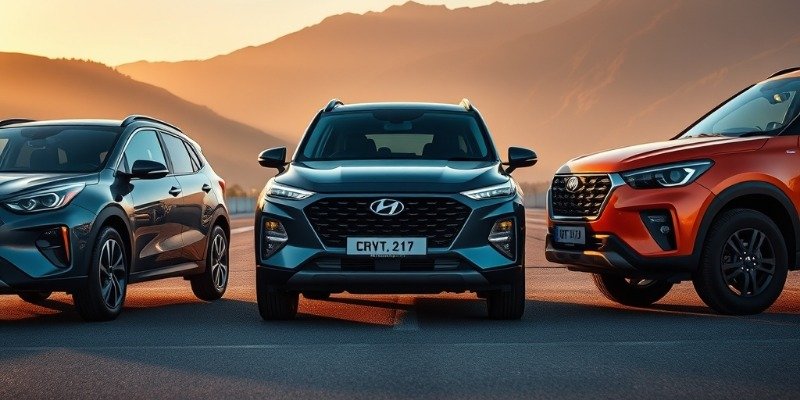
The Indian electric SUV space is heating up with three distinct mid-size contenders arriving from different corners of the automotive world. The Kia EV5 brings global e-GMP platform credentials with a boxy, practical design. The Hyundai Creta Electric leverages India's best-selling SUV nameplate with locally relevant packaging. The Mahindra XUV.e8 represents the homegrown brand's push into the premium electric segment with its new INGLO platform. Each vehicle targets a slightly different buyer, and understanding their strengths will help you decide which one is worth the wait.
Design and Platform Approach
The Kia EV5 adopts a traditional two-box SUV silhouette that prioritises interior space over aerodynamic flair. It sits on the familiar e-GMP platform but uses a 400-volt electrical architecture instead of the 800-volt system found in the EV6 and EV9. This decision keeps costs down but limits peak charging speed. The design language features Kia's signature star-map lighting signatures front and rear, giving the boxy shape a modern identity. At 4.6 metres long, it slots neatly into the mid-size segment with a practical stance.
The Hyundai Creta Electric builds on the existing Creta platform, adapted for electric propulsion. It retains the familiar Creta proportions at 4,340 mm length but gains EV-specific styling cues like a closed grille, new lighting elements, and aerodynamic wheels. The platform allows Hyundai to leverage existing manufacturing lines while offering a product that feels familiar to the massive Creta customer base.
The Mahindra XUV.e8 is the first product on the company's new INGLO dedicated EV platform. It features a cab-forward design with short overhangs, maximising interior space within its footprint. The styling previews Mahindra's new electric design language with distinctive lighting elements and a clean, aerodynamic profile. Being a ground-up EV platform, it offers packaging advantages that adapted platforms cannot match.
Battery, Range, and Charging
The Kia EV5 comes with an 81.4 kWh NMC lithium-ion battery (78 kWh usable) in its international specification. The WLTP claimed range is 503 km (313 miles) for the standard version. It supports DC fast charging up to 127 kW on its 400-volt architecture, with a claimed 10-80% time of 30 minutes. However, real-world testing has shown charging speeds often fall below the claimed maximum, sometimes reaching only 40-50 kW on public chargers. AC charging tops out at 11 kW. A heat pump is optional on higher trims.
The Hyundai Creta Electric offers two battery options. The base variant gets a 42 kWh battery with an ARAI claimed range of 390 km. The long-range variant uses a larger 51.4 kWh battery delivering up to 510 km ARAI range. Both use lithium-ion chemistry. Charging details for the India-spec model are still emerging, but the platform supports DC fast charging. The 42 kWh variant takes about 4 hours for a full AC charge based on comparable specifications.
The Mahindra XUV.e8 packs an 80 kWh battery, the largest of the three, with a claimed range of 450 km. The INGLO platform supports 800-volt architecture, enabling ultra-fast DC charging capability. Mahindra has claimed the platform can add significant range in very short charging sessions, though exact India-spec charging curves are awaited. The larger battery and higher voltage architecture give it a theoretical advantage for long-distance travel.
Performance and Driving Dynamics
The Kia EV5 in its standard international guise produces 214 hp (160 kW) and 218 lb-ft (295 Nm) of torque from a single front-mounted motor. The 0-62 mph (0-100 km/h) sprint takes 8.4 seconds. The driving experience is tuned for comfort over sportiness. The ride absorbs urban imperfections well, though the 2,090 kg curb weight makes itself felt over larger bumps. Steering is light and predictable, suited for city and highway cruising. Three regenerative braking levels plus an i-Pedal one-pedal mode offer flexibility.
The Hyundai Creta Electric's base 42 kWh variant produces 133 hp (99 kW), while the long-range 51.4 kWh version delivers 169 hp (126 kW) with 255 Nm torque. The long-range variant claims a 0-100 km/h time of 7.9 seconds. Being lighter than the EV5, it feels more agile in city traffic. The platform's familiarity means ride and handling characteristics will be well-understood by Indian buyers. Drive modes include Eco, Normal, and Sport.
The Mahindra XUV.e8 leads on paper with 250 hp (186 kW) from its electric motor. The 80 kWh battery and 800-volt platform suggest strong performance potential. Specific acceleration figures for the India-spec model are not yet confirmed, but the power advantage over both rivals is significant. The dedicated EV platform should offer better weight distribution and a lower centre of gravity compared to adapted platforms, promising engaging dynamics for a family SUV.
Interior Space and Practicality
The Kia EV5's boxy shape translates to excellent interior space. The 2,750 mm wheelbase (based on global specs) provides generous rear legroom with a flat floor. Boot capacity stands at 566 litres with seats up, expanding to 1,650 litres with seats folded. A 44-litre frunk adds extra storage. The cabin features dual 12.3-inch screens, physical climate controls, and a column-mounted gear selector that takes some getting used to. Rear passengers get USB-C ports on higher trims. No seven-seat option is available.
The Hyundai Creta Electric offers 433 litres of boot space, which is competitive for the segment. The 2,610 mm wheelbase provides good rear seat space, though the floor isn't completely flat due to the adapted platform. The interior carries over the Creta's dual 10.25-inch curved display setup with wireless Apple CarPlay and Android Auto. Higher trims get a Bose 8-speaker system, ventilated front seats, and powered driver seat with memory. Rear AC vents and charging ports are standard.
The Mahindra XUV.e8's INGLO platform promises class-leading interior space with a completely flat floor and optimised packaging. Specific dimensions for the India-spec model are not yet fully disclosed, but the cab-forward design and dedicated EV architecture should maximise passenger room. Boot space figures are awaited. The interior is expected to feature a large central touchscreen, digital instrument cluster, and sustainable materials in line with Mahindra's new design direction.
Features and Technology
The Kia EV5 comes well-equipped even in base trim. Standard features include LED lighting, dual-zone climate control, 12.3-inch infotainment with built-in navigation and charger locator, 12.3-inch digital cluster, wireless phone charging, and a comprehensive ADAS suite with blind-spot view monitor. Higher trims add a panoramic sunroof, heated and ventilated seats, heated steering wheel, head-up display, and streaming apps via subscription. Pet mode for climate control with screen notification is a unique touch.
The Hyundai Creta Electric builds on the Creta's strong feature list. All variants get dual 10.25-inch screens, wireless smartphone connectivity, automatic climate control with rear vents, six airbags, and Level 2 ADAS (SmartSense) on higher trims. The long-range variant adds a Bose premium audio system, ventilated seats, powered driver seat with memory, digital key, and powered tailgate. Connected car features include remote climate control and charging management via smartphone app.
The Mahindra XUV.e8 is expected to debut Mahindra's latest connected car ecosystem with over-the-air updates, advanced voice assistance, and a feature set aimed at the premium segment. Specific equipment lists for India are not yet confirmed, but the platform supports advanced ADAS, large displays, and premium audio. Mahindra's focus on software-defined vehicle capabilities suggests a strong tech proposition.
Safety
The Kia EV5 inherits Kia's comprehensive safety suite including six airbags, ESC, hill-hold assist, and Level 2 ADAS with forward collision avoidance, lane keeping assist, blind-spot collision avoidance, and rear cross-traffic alert. The blind-spot view monitor that activates with the turn signal is particularly useful. Structural safety benefits from the e-GMP platform's reinforced battery protection.
The Hyundai Creta Electric offers six airbags standard across all variants, ESC, hill-hold assist, and Level 2 ADAS on higher trims with similar functionality to the Kia. The Creta platform has a 5-star Global NCAP rating for the ICE version, though the EV variant's specific rating is awaited. All-wheel disc brakes and electronic parking brake are standard.
The Mahindra XUV.e8's INGLO platform is engineered for high structural rigidity with integrated battery protection. Mahindra's recent products have scored well in Bharat NCAP testing, and the XUV.e8 is expected to target a 5-star rating. Standard safety equipment will likely include six airbags, ESC, and advanced ADAS features. The dedicated EV platform allows optimised crash structure design without compromise.
Pricing and Positioning
The Kia EV5's UK pricing starts at £39,345 (approximately ₹42 lakh) for the base model, rising to £47,145 (₹50 lakh) for the GT-Line S. India pricing is not announced but Kia typically positions its EVs competitively. If launched in India, it would likely target the ₹35-45 lakh segment, competing with the Hyundai Ioniq 5 and Volvo EX30.
The Hyundai Creta Electric starts at ₹18.02 lakh ex-showroom for the 42 kWh Executive variant, ranging up to ₹24.55 lakh for the long-range Excellence trim. This aggressive pricing undercuts most direct rivals and positions it as the most accessible mid-size electric SUV in India. The price gap between base and top variants is approximately ₹6.5 lakh, offering clear step-up value.
The Mahindra XUV.e8 is expected to start around ₹25 lakh ex-showroom for the base Pack One variant, positioning it firmly in the premium segment. This is approximately ₹7 lakh more than the Creta Electric's top variant. The premium reflects the larger battery, dedicated platform, higher power, and 800-volt architecture. Mahindra's pricing strategy will determine how it competes with the Hyundai Ioniq 5, Kia EV6, and entry-level luxury EVs.
Real-World Efficiency and Usability
The Kia EV5 achieved around 3.3 miles per kWh (approximately 5.3 km/kWh) in mixed UK driving against a WLTP claim of 3.8 mi/kWh. Cold weather significantly impacts range. The 400-volt architecture means charging sessions on long trips take longer than 800-volt rivals. Home charging at 7-11 kW makes daily use convenient for those with charging access.
The Hyundai Creta Electric's real-world efficiency data for India is not yet available. The 42 kWh variant's 390 km ARAI range suggests around 250-280 km in mixed city-highway driving. The 51.4 kWh long-range variant's 510 km claim should deliver 350-400 km realistically. Hyundai's thermal management and India-specific calibration should help in local conditions.
The Mahindra XUV.e8's 80 kWh battery and 450 km claimed range suggest a real-world figure of 350-380 km. The 800-volt platform's faster charging capability makes it better suited for intercity travel, provided the charging infrastructure supports high-power delivery. Mahindra's experience with the XUV400 EV gives it a baseline for India-specific efficiency tuning.
Which One Should You Wait For?
If your budget is under ₹25 lakh and you need a practical family EV for primarily city and occasional highway use, the Hyundai Creta Electric makes the strongest case. Its aggressive pricing, proven platform, strong feature list, and Hyundai's extensive service network make it the lowest-risk choice. The long-range variant's 510 km claim addresses range anxiety effectively for most Indian usage patterns.
If you can stretch to ₹35-45 lakh and want a global product with advanced platform technology, the Kia EV5 offers a compelling package. Its boxy design maximises space, the e-GMP platform is proven globally, and Kia's feature loading is generous. The 400-volt charging limitation is a consideration for frequent long-distance travellers, but for urban and suburban use with home charging, it is a non-issue. India launch timing and pricing remain the key unknowns.
If you prioritise cutting-edge EV technology, maximum performance, and plan frequent intercity travel, the Mahindra XUV.e8's 800-volt architecture, 80 kWh battery, and 250 hp output make it the most future-proof option. The dedicated INGLO platform offers packaging and efficiency advantages that adapted platforms cannot match. The premium pricing reflects this positioning. Mahindra's growing EV service network and the platform's scalability for future models add long-term value.
FAQs
What is the expected price range for each SUV in India?
The Hyundai Creta Electric is already launched at ₹18.02-24.55 lakh ex-showroom. The Mahindra XUV.e8 is expected to start around ₹25 lakh ex-showroom. The Kia EV5 India pricing is unannounced but international pricing suggests a ₹35-45 lakh positioning if launched locally.
Which SUV has the largest battery and longest claimed range?
The Mahindra XUV.e8 has the largest battery at 80 kWh with a 450 km claimed range. The Hyundai Creta Electric long-range variant has a 51.4 kWh battery with 510 km ARAI range. The Kia EV5 has an 81.4 kWh battery with 503 km WLTP range internationally.
Do all three support 800-volt ultra-fast charging?
Only the Mahindra XUV.e8 confirms 800-volt architecture on its INGLO platform. The Kia EV5 uses 400-volt architecture with 127 kW peak charging. The Hyundai Creta Electric's charging architecture details for India are not fully specified yet.
Which SUV offers the most boot space?
The Kia EV5 leads with 566 litres (seats up) and 1,650 litres (seats folded) plus a 44-litre frunk based on global specs. The Hyundai Creta Electric offers 433 litres. The Mahindra XUV.e8 boot space is not yet confirmed for India.
When will each SUV be available for purchase in India?
The Hyundai Creta Electric is available now. The Mahindra XUV.e8 is expected to launch in 2025. The Kia EV5 India launch timeline has not been officially confirmed.